95% of AI projects in mid-market companies fail to deliver the expected value. Not because the technology doesn't work, but because the wrong use case was chosen. Selecting the first use case is the single most important decision a company makes on its path to AI-driven value creation.
This article shows how to recognise a good first use case, which typical mistakes to avoid during selection, and what the path from interest to a concrete project looks like.
The most common mistake: automating small everyday problems
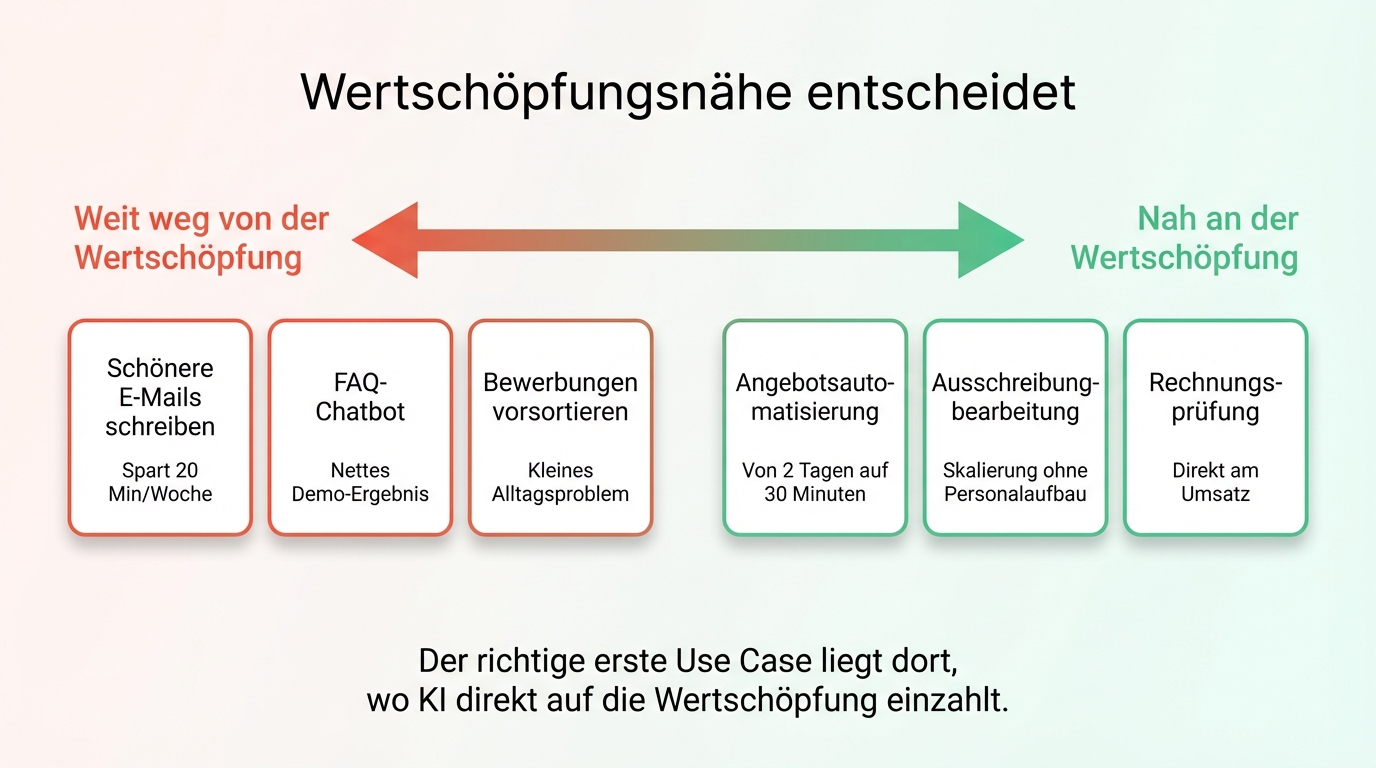
When companies think about AI for the first time, they reach for obvious ideas: writing better emails, pre-screening job applications, reviewing contracts. It sounds reasonable. A concrete problem, a manageable scope, easy to demonstrate.
The problem: these use cases sit too far from the company's actual value creation. A slightly better email changes nothing about the bottom line. Automated contract review might save twenty minutes a week. That's not enough to convince an organisation that AI can transform its business.
A similar pattern: the chatbot on the FAQ page. That was the first thing the technology could do well two and a half years ago. A chatbot is not a use case. It's a form factor. It doesn't answer the question of where the biggest lever lies for the company.
Companies that start with projects like these get a nice demo result at best. What's missing is proof that AI makes a substantial difference.
The four traits of a good first use case
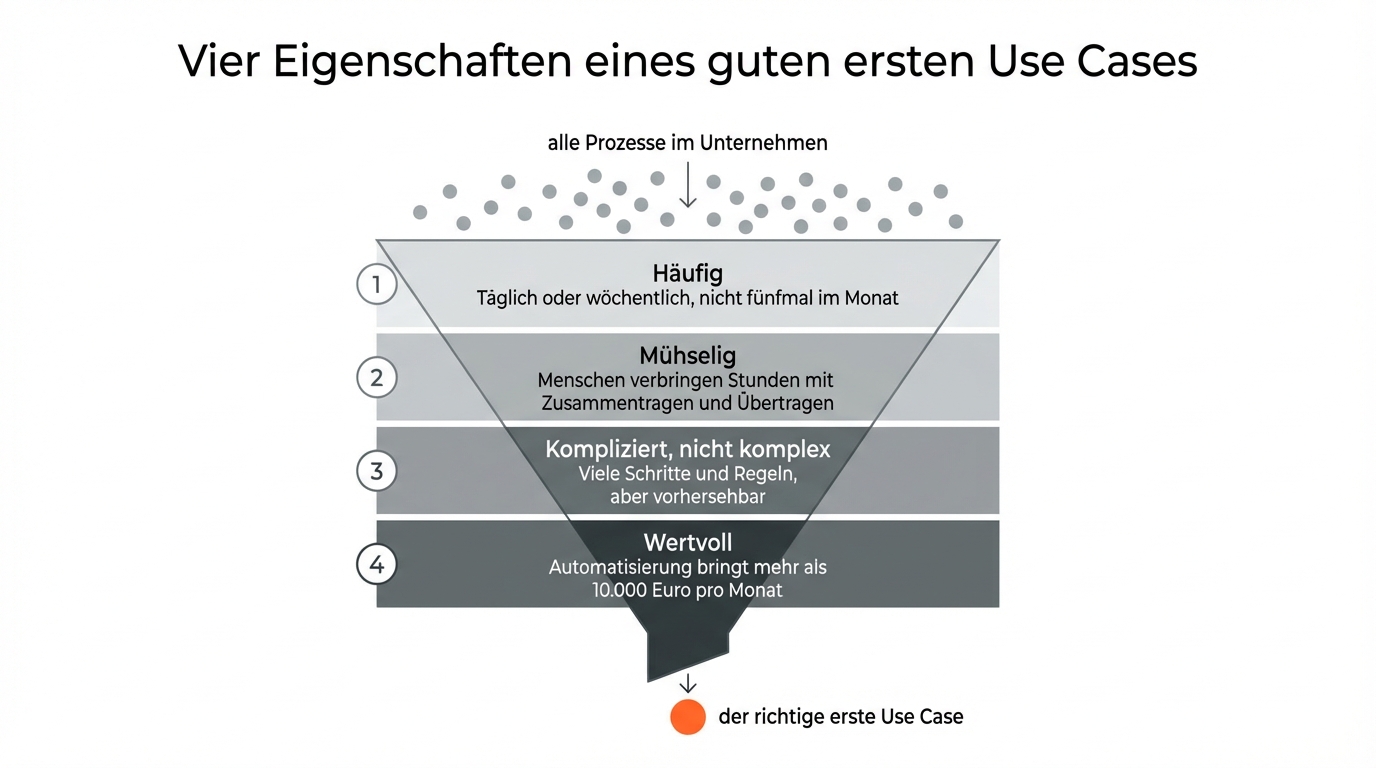
A good first AI use case has four characteristics. All four should apply.
Frequent: The process happens regularly, ideally daily or weekly. Something that occurs only five times a month won't justify the investment.
Tedious: People spend hours or days gathering information, reading documents, transferring data from one system to another. It's work that qualified employees do, but that doesn't match their qualifications.
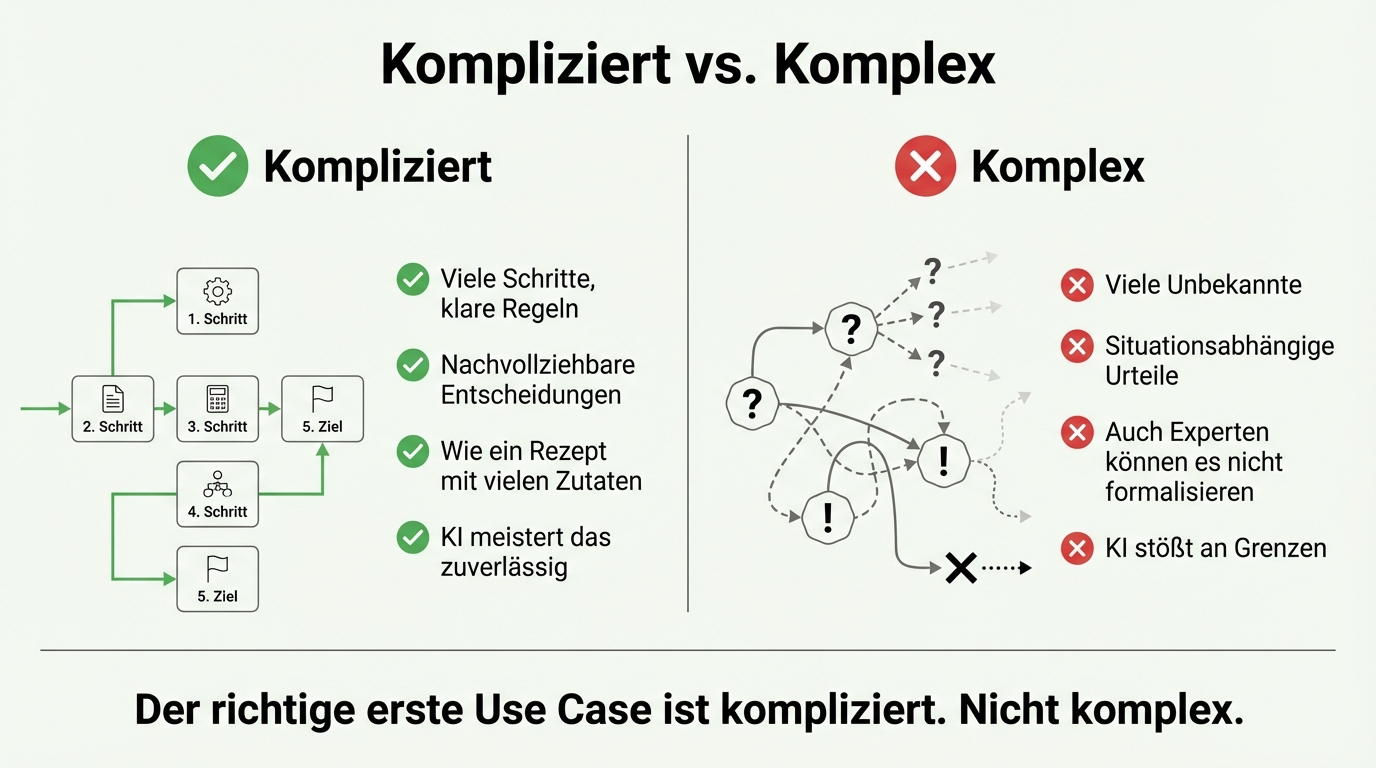
Complicated, not complex: Complicated means many small steps, clear rules, traceable decisions. Complex means many unknowns, situational judgements that even experienced employees can't formalise. AI handles the complicated reliably. With the complex, it hits its limits.
Valuable: Automation should free up value in the order of 10,000 euros or more per month. That can be saved working time, but also faster response times, higher capacity, or better quality.
The best use case combines all four traits: a process that people find tedious, that occurs frequently enough to justify the investment, that is rule-based enough to automate, and that sits close enough to value creation to make a noticeable difference.
Three questions every managing director should ask
Before selecting a specific use case, three questions help find the right direction:
1. Where is the biggest bottleneck in my company? Not the biggest annoyance, but the biggest bottleneck. Where do orders pile up because the team can't keep pace? Where do we lose business because we react too slowly? Where is the constraint whose removal enables growth?
2. Does it happen frequently enough or is it valuable enough? A process that runs once a quarter is not a good first use case. The investment must be justified either by frequency or by the value of each individual transaction.
3. Do I truly believe this is necessary? The decisive question is not technical, but strategic. Those who see AI as an experiment because the hype is big right now will stop at the first obstacle. Those who have recognised that the transformation of knowledge work is happening right now, and that their company must adapt, bring the persistence a first project requires.
Why the first use case achieves more than expected
A common misconception: the first AI use case automates a process. In reality, it does considerably more.
To automate a process, you first have to understand it. Truly understand it. In many companies, that understanding lives in the heads of individual employees. There is no complete documentation of how proposals are written, enquiries processed, or invoices reviewed. Experienced employees know how it's done. New hires learn by watching and asking.
AI forces this implicit knowledge to be written down. That alone is already valuable: companies that have once made their processes truly explicit discover inconsistencies, unnecessary steps, and opportunities for improvement. The first AI use case becomes a catalyst for process improvement that would have been valuable even without AI.
And it opens a mindset. Companies that have a successful first AI project behind them understand far more concretely what is possible afterwards. The first use case is the door opener for everything that follows.
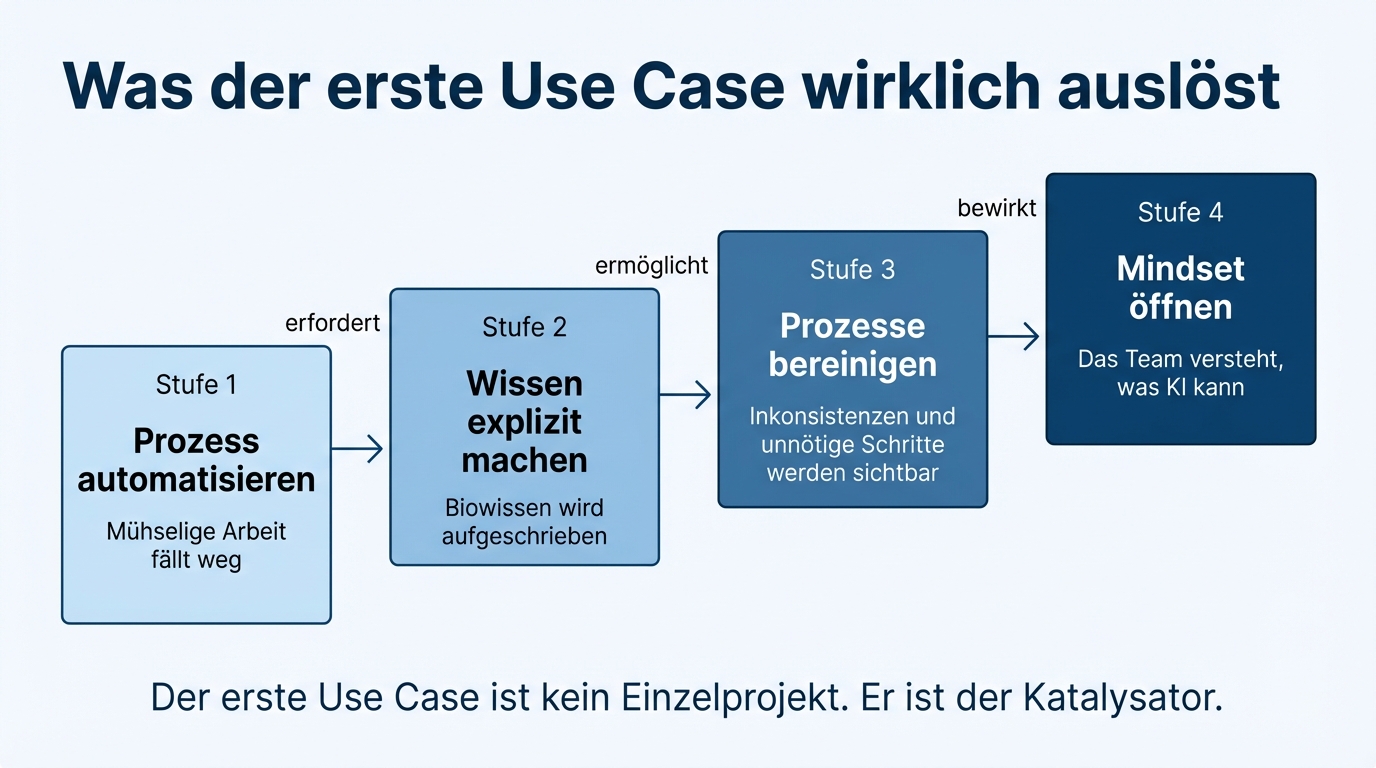
What it takes on the client side
Three prerequisites determine whether a first AI project succeeds:
Clear commitment from a decision-maker. Not curiosity, not "we should probably do something with AI". A person who sees the bottleneck, considers the change necessary, and is willing to allocate resources for it.
A process owner who knows the process. At the start, an AI project needs four hours a week from the person who understands the process best. After that, one to two hours weekly. Without this domain expertise, the AI lacks the context it needs.
Access to the IT systems. The best use cases automate work between existing systems. For that, AI needs access to the data and interfaces of those systems. Pragmatism in IT integration accelerates every project significantly.
Conversely, there are warning signs that point to a difficult project: when decision-makers have no time, when access to the company's own data is difficult, or when the company rejects cloud services on ideological grounds.
Start small, deliver value fast
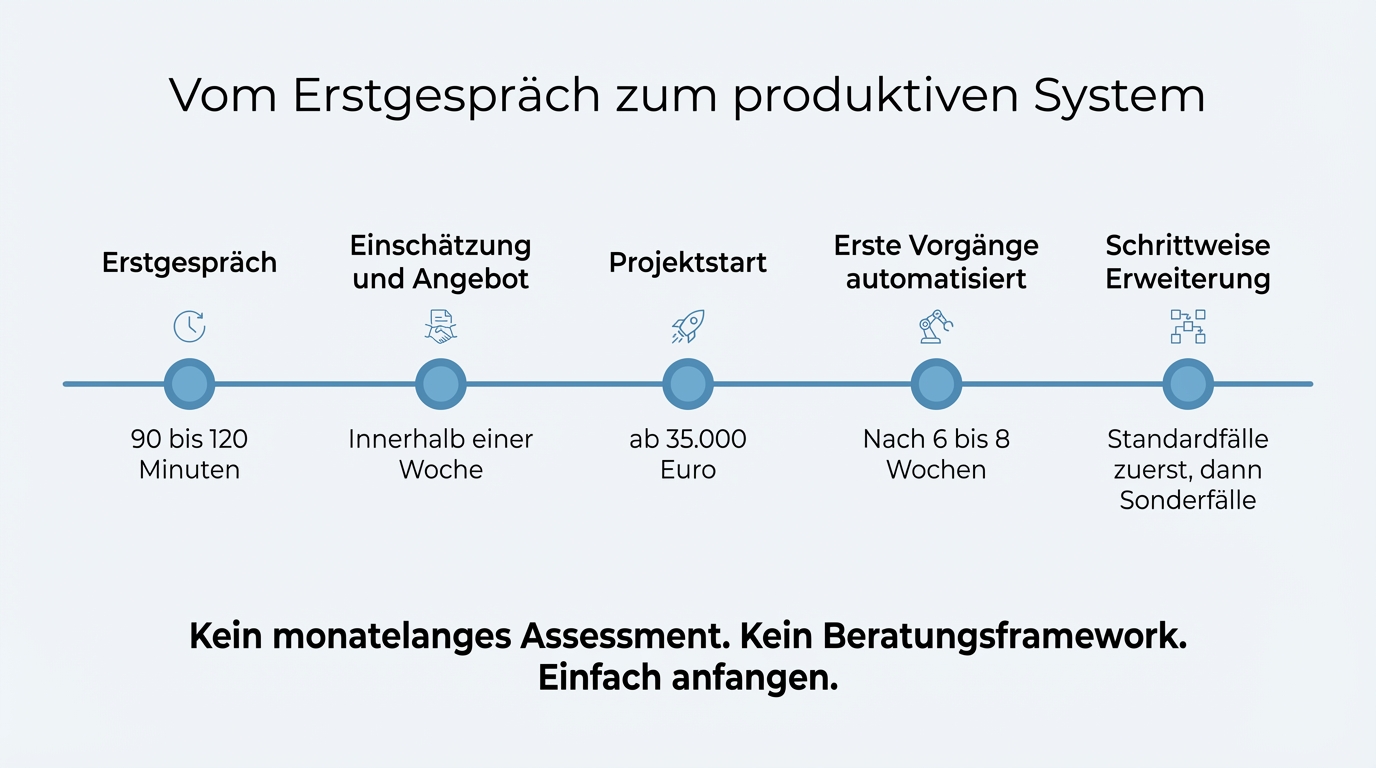
The right entry point is not a strategy project, but a concrete implementation project. First projects typically run in the range of 35,000 euros and can be started in a few weeks. After six to eight weeks, the system should be processing its first transactions.
The strategy: cover the frequent, straightforward standard case first. Edge cases and exceptions stay with humans. The goal is not 100% automation, but noticeable relief. When a team suddenly spends only half its time on the tedious part, that is clear proof that AI works.
This approach is deliberately lightweight. No months-long assessment, no elaborate consulting framework. After one or two conversations, often 90 to 120 minutes, it's clear whether and where a good first use case exists. Then it starts.
Not because diligence doesn't matter. But because the biggest risk is not the wrong use case. It's never starting at all.