
The most honest answer to the most common question we hear: between 15,000 and 60,000 euros for initial development. No licenses, no long-term contracts. Productive in three to four months. And after that? A few hundred euros a month.
But that's only half the story. The real question isn't what an AI project costs. It's what it costs not to do one.
The three price tiers we see in practice
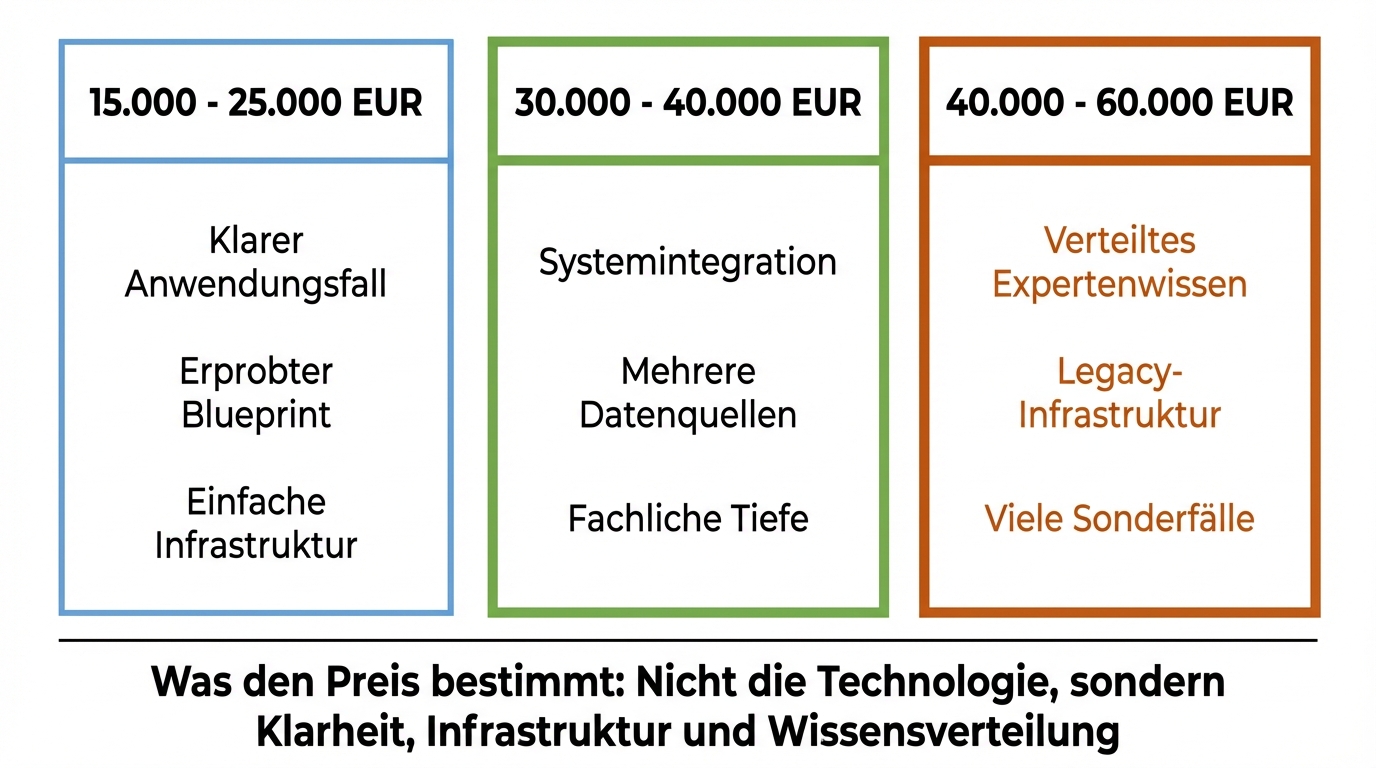
Not every AI project is equally complex. From our experience with mid-market companies, three tiers have emerged:
15,000 to 25,000 euros: A clearly defined use case that we've already built in a similar form. Low uncertainty, clear blueprint. A customer support agent, a document classification system, a knowledge search across internal sources.
30,000 to 40,000 euros: Medium complexity. Integration into an existing system, multiple data sources, domain depth that needs to be developed. An AI-powered proposal workflow that connects to your ERP. An agent that orchestrates process steps across multiple systems.
40,000 to 60,000 euros: High complexity. The knowledge lives in many heads, not one. The infrastructure has grown organically. There are many edge cases. The system needs to integrate into legacy environments and consolidate expertise from different sources.
What makes the difference? Not the technology. That's the same across all three tiers. It comes down to three factors: How clearly defined is the use case? How complex is the infrastructure it needs to integrate with? And how distributed is the domain knowledge that needs to flow into the solution?
What you get for your money
We don't work with licenses or subscriptions. What we build belongs to you. The code, the infrastructure, the deployment. You're not locked in to us.
A typical project works like this:
First results within a few weeks. After four to six weeks you have a working system that your domain experts can try out and evaluate. Not a presentation, not a concept paper. A system that processes real inputs and delivers real results.
Productive in three to four months. The second half of the project matters more: domain experts train the system, edge cases are handled, integration into daily workflows is done properly. This is where the real value is created, because a system that works technically but nobody uses is worthless.
No license fees. The code and the solution become your property. You don't need us to keep the system running. If your IT team can and wants to take over hosting, that's possible.
The costs that rarely appear in a quote
An AI project has ongoing costs. They're manageable, but you should know about them.
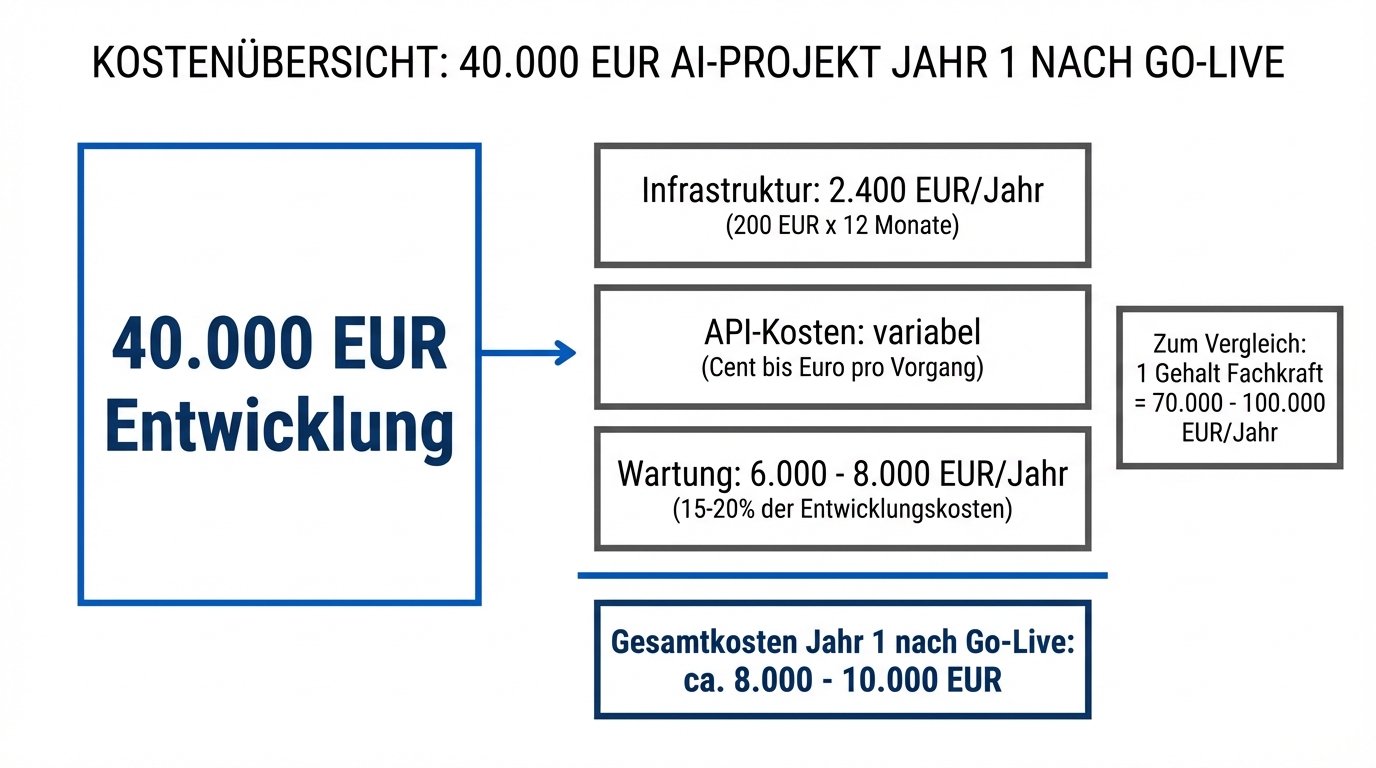
Infrastructure: Between 50 and 300 euros per month, depending on the cloud platform and architecture. Azure tends to be more expensive, Google Cloud with modern serverless approaches is often cheaper. With smart planning, you can stay under 100 euros per month.
API costs: Every request to a language model costs money. For a support agent handling thousands of requests per month, it's a few cents per conversation. For a complex proposal automation that needs multiple model calls per run, it can be one to two euros per cycle. In any case: the value per run must exceed the cost, and it typically does by a wide margin.
Maintenance: Budget 15 to 20 percent of development cost per year. That covers security updates, model switches when a provider discontinues a model, and minor adjustments. No feature extensions, no new functionality. Just keeping the system running cleanly.
Summed up, as an example: a 40,000-euro project generates ongoing costs of roughly 200 euros per month for infrastructure and API plus 6,000 to 8,000 euros per year for maintenance. Those are the real numbers you can plan with.
When the investment pays off
The classic payback calculation often falls short for AI projects. Of course you can calculate: if a process that used to take hours shrinks to minutes, you save working time. But the real value lies elsewhere.
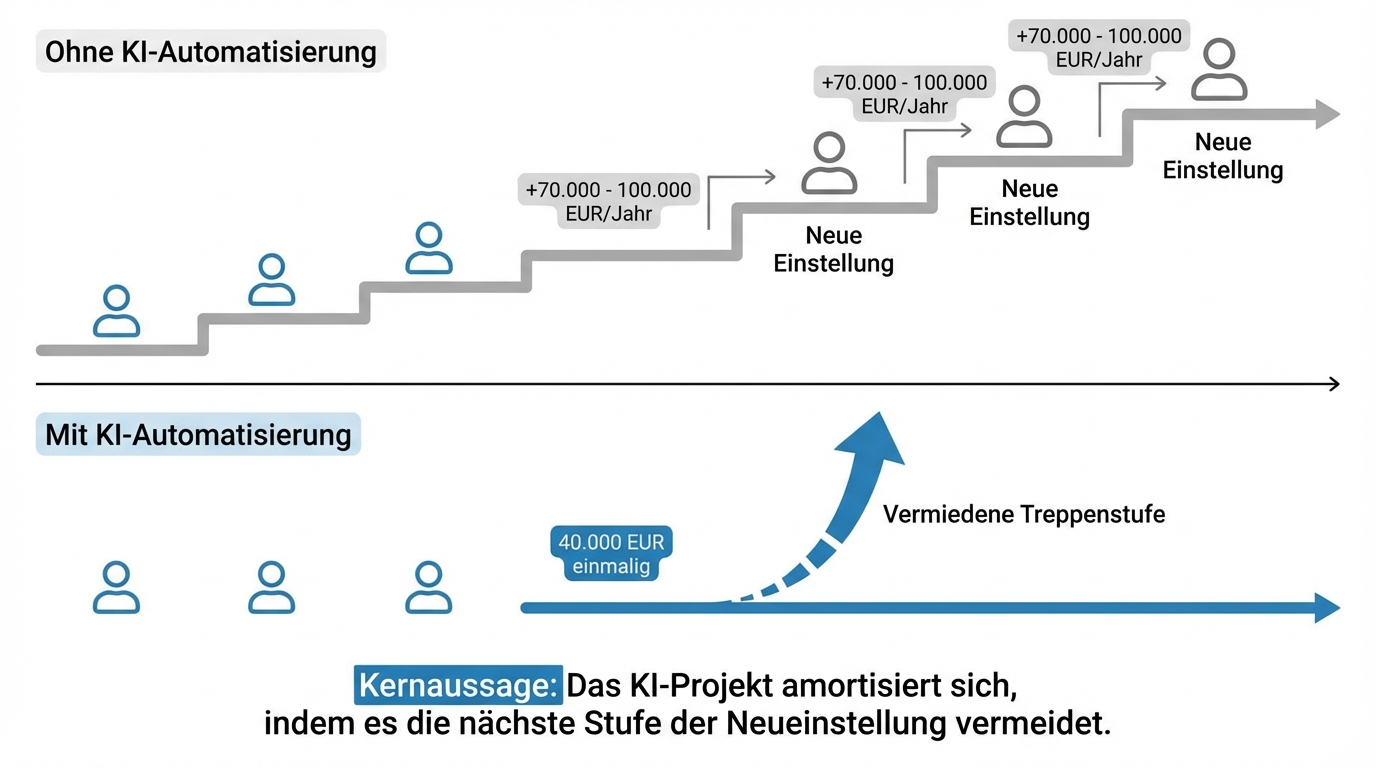
AI automation creates machine-level scalability. Growing a team from three to ten people doesn't just cost salaries. It costs recruiting, onboarding, management structures, turnover. It takes months before new hires are productive. And every growth step brings organisational friction.
If instead you can achieve the same output with the existing team, you avoid those step changes. One saved salary in a typical specialist department runs 70,000 to 100,000 euros per year. That means a 40,000-euro project pays for itself in less than a year -- not through savings, but through avoided growth.
That's not a guarantee. It's an experience-based benchmark from projects where companies were growing fast or had a clear bottleneck. The reality is: even in companies that know their internal processes well, a precise ROI calculation upfront is difficult. What we can say with certainty: you'll see within the first few weeks whether the system delivers value.
Why not cheaper?
Below 15,000 euros it becomes difficult to build a custom integration that delivers real value. We need time to understand your process, choose the right architecture, and sharpen the solution with your domain experts.
For standard problems that many companies share, there are increasingly off-the-shelf solutions: chatbots for customer support, summarisation tools for meetings, assistants for text generation. If such a solution solves your problem, we recommend it. Buying a SaaS solution for 50 euros a month is better than spending 20,000 euros on a custom build.
Custom development pays off where your processes, your data, or your domain knowledge are too specific for a standard solution. Where AI isn't just applying generic knowledge, but your industry knowledge, your price lists, your product configurations, your way of writing proposals.
Three things that determine success or failure
We see companies that have failed with other partners or on their own. Typically not because of the technology, but because of three missing prerequisites:
Someone has to truly want it. Not "let's see what AI can do". A person with decision authority who says: we are changing this process, because we have to. Without that determination, every project fizzles out after the first results.
It takes a domain expert who invests time. We call this role the "agent operator": the person who knows the process best, who knows why things work the way they do. Four hours a week at the start, then one to two hours. Without this person, you build a system that works technically but misses the mark professionally.
Access to systems, without bureaucracy. The most common time sink in AI projects isn't development. It's waiting for access, approvals, and interfaces. Companies that act pragmatically and fast here get results in weeks. Companies where every access requires three sign-offs take months.
What your company's infrastructure does to the cost
A factor that appears in no price list but can influence costs by up to 300 percent: your existing IT infrastructure.
If your company already uses a cloud environment -- Microsoft Azure, Google Cloud, or comparable -- and we can get a resource group or project there, deployment is fast and affordable.
If we need to hook into a foreign infrastructure network with policies, VPN tunnels, and approval processes, the effort multiplies. Not because the solution would be different, but because the path to get there is longer.
That's why we clarify the cloud question early. It affects the price more than the choice of language model.
How such a project runs with us is described on our page on custom AI development.
The next step
We don't do six-month strategy projects. We start with a concrete process, build a productive solution in three to four months, and then decide together what comes next.
If you want to know which price tier your project falls into: get in touch. We'll give you an honest assessment within a few days, before anyone writes a quote.