
This quarter, we haven't created a single proposal manually. Not because we write fewer proposals, but because AI delivers the first draft in five to ten minutes -- work that used to take an entire day. This isn't a future vision. It's been our daily reality since early 2026.
What's true for proposal creation applies to dozens of other administrative processes: document review, cost estimates, profile creation, client correspondence. Tasks that used to require days of capacity can now be done in a fraction of the time. The question is no longer whether AI improves productivity. The question is whether your company can afford to ignore it.
The competition isn't waiting
"Our competitors are already using AI for specifications and tenders." Those aren't the words of a consultant. They come from the managing director of a mid-market company explaining why he has to act.
The mechanism is simple: whoever can create proposals faster processes more tenders. Whoever processes more tenders wins more contracts. One department head put it this way: his team needs capacity relief just to be able to handle the comprehensive tenders again. Faster processing means more submissions, more submissions means more wins.
This isn't abstract strategy. It's arithmetic: if your competitor creates a proposal in ten minutes and you need ninety, they handle nine times as many requests in the same time. Not nine percent more. Nine times as many.
What AI already delivers today: before and after
The most convincing evidence for the productivity lever isn't theoretical models but concrete before-and-after comparisons from live systems.
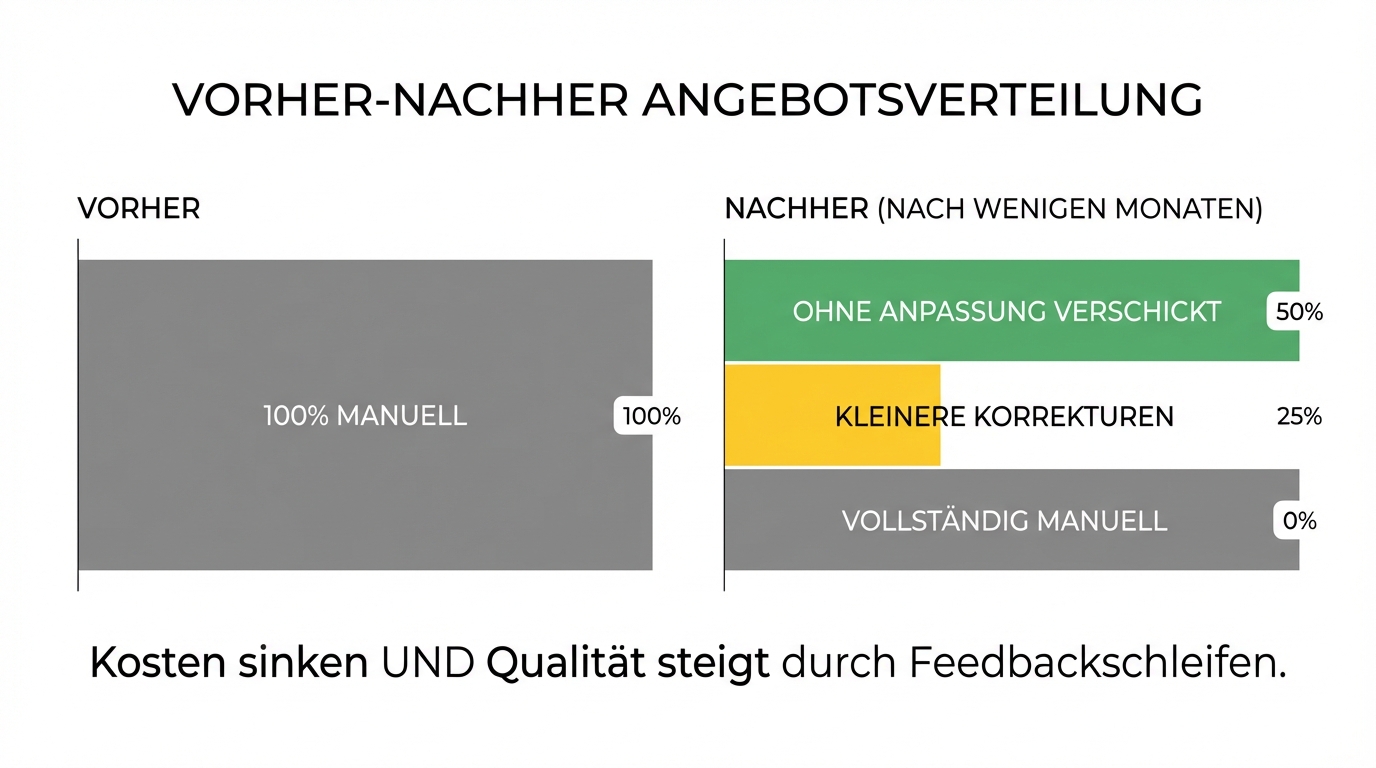
In companies with high proposal volumes, a clear pattern emerges: after a few months in operation, experience shows that more than half of all proposals are sent without manual adjustment. Another quarter needs only minor corrections. Only a fraction is still written entirely by hand. These benchmarks come from complex environments with custom configurations and high variance. For simpler proposal structures, automation rates are even higher.
The double effect that surprises many: costs drop and quality rises at the same time. That contradicts the intuition that automation inevitably means quality loss. The key is feedback loops: every correction by a domain expert improves the next generation. The system learns, and quality improves continuously.
Three dimensions of productivity gains
Time savings is the most obvious argument, but not the strongest. The full productivity gain shows up in three dimensions.
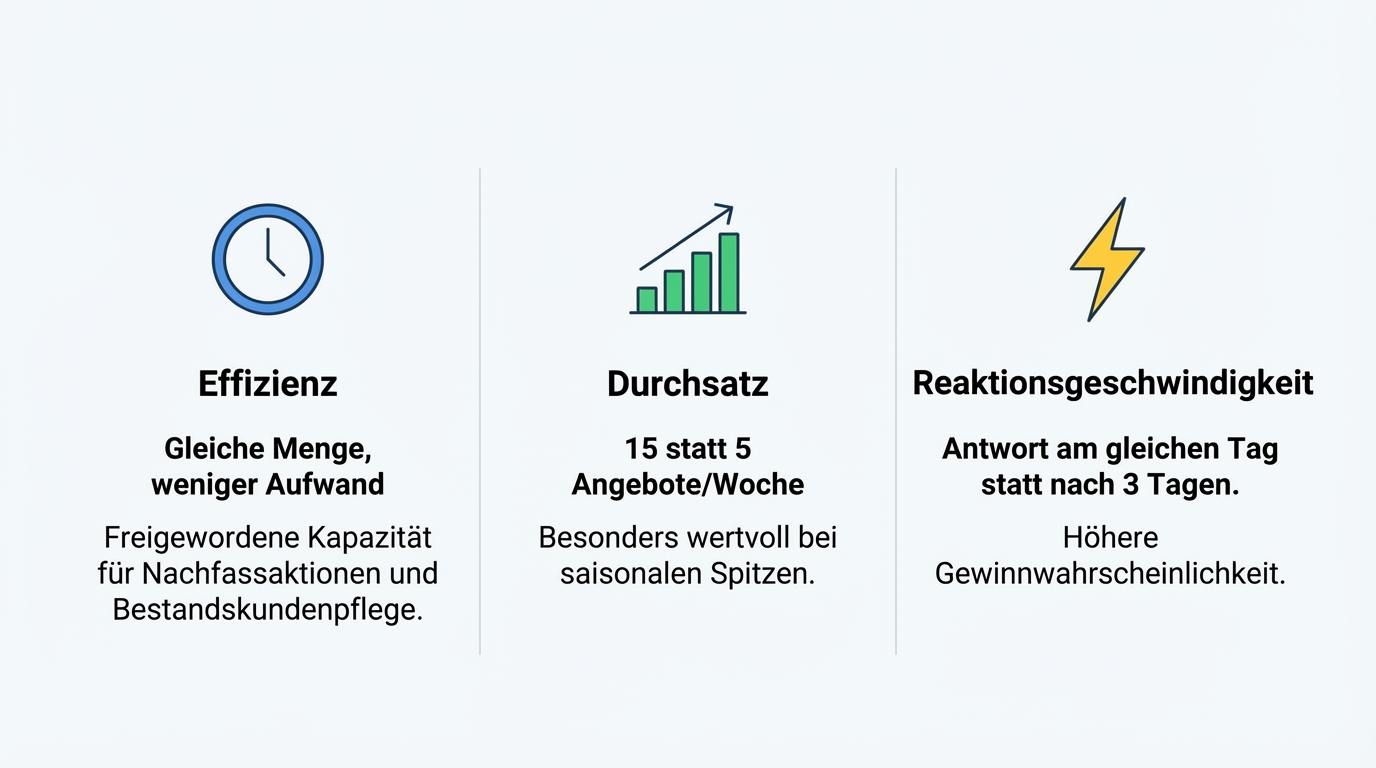
Efficiency: same volume with less effort. The existing team does the same work in less time. That frees up capacity for tasks that used to fall through the cracks: follow-ups, account management, quality assurance.
Throughput: more output with the same team. Instead of five proposals per week, fifteen go out. The team doesn't grow, but the output rate climbs. Especially valuable during seasonal peaks, when the backlog would otherwise linger for weeks.
Response speed: less drop-off through faster answers. When a client waits three days for a proposal, they've already received two others. A same-day response changes the win probability. The formal causation is hard to prove, but the operational evidence from multiple projects is clear: faster proposals lead to more wins.
The step function: where the ROI really lies
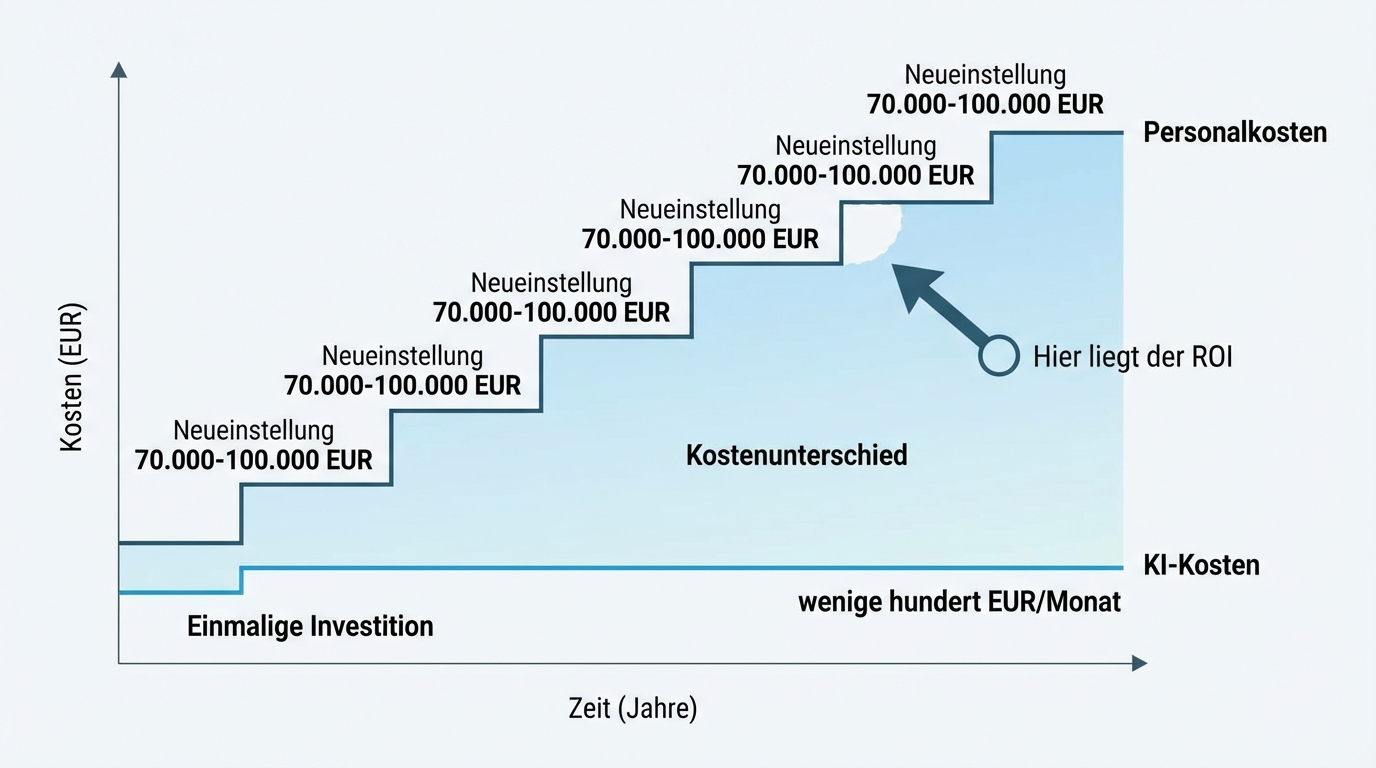
The honest answer to "When does it pay off?" is: at the next hire you no longer need.
The classic growth pain in mid-market companies is the step function. Beyond a certain workload, the existing team can't keep up. So another person is hired -- cost: 70,000 to 100,000 euros per year including overhead. That's a big jump that only pays off if volume stays permanently high enough.
AI shifts that step. Instead of an additional person, the company makes a one-time investment in a system that absorbs the extra demand. Ongoing operating costs typically run at a few hundred euros per month for infrastructure. The investment pays for itself as soon as the next step doesn't need to be taken.
That's a different argument from "we save 30 minutes per proposal". It's a structural argument: AI changes the cost structure of growth. Less fixed cost, more scalability, smaller jumps.
Eliminate administrative overhead, don't just optimise it
One managing director framed his goal like this: "Administrative overhead close to zero." Not 30 percent less. Close to zero. His reasoning: his best sales person generates seven-figure revenue per year. Every minute that person spends on admin work is lost revenue.
The automation philosophy behind it: eliminate the tedious, the frequent, and the complicated so that people can focus on the exceptional. Not replacing people, but freeing them.
That this isn't a platitude is proven in practice. In accounting, in proposal creation, in document review, in meeting preparation: everywhere there are tasks that are necessary but contribute little to actual business success. AI can't eliminate all of them overnight, but for the right processes the lever is enormous. Experience shows reductions by a factor of five to ten for repetitive tasks.
Start small, scale strategically
The most common mistake: thinking too big and therefore never starting at all. The search for the perfect AI strategy for the entire organisation takes six months and delivers a concept paper. In the same time, a concrete project would have already produced measurable results.
The proven path: one process, one clearly defined problem, a manageable budget. Within a few weeks there's a working system delivering first results. That initial success has double value: it demonstrates concrete benefit, and it sets the precedent for further projects.
The strategic perspective then follows naturally. Companies that started with one process quickly see the transferability. What works for proposal creation works similarly for profile generation, client correspondence, and document review. One corporate group set itself the goal of automating 50 to 100 processes at a 50 percent automation rate. Not in the distant future, but as an operational target.
Private equity investors already recognise the lever: AI automation across multiple portfolio companies, rolled out systematically. What starts as a single project becomes a strategic advantage.
What happens to the people
The honest question behind the productivity discussion: if 60 percent of the work is automated, what happens to the employees?
The answer is more nuanced than "everyone gets replaced" or "nobody loses their job". Demographic change means many companies already struggle to fill open positions. Automation solves a problem that already exists: too much work for too few people.
The best specialists focus on what requires judgement: complex edge cases, strategic decisions, client relationships. At the same time, tasks become feasible that were previously neglected because there simply wasn't capacity. The staffing question is a leadership decision every managing director has to answer for their company. But from a competitive standpoint, it's unavoidable.
The next step
Identify the one process in your company that consumes the most time and runs most uniformly. Bring it to a conversation. We'll show you what the before-and-after comparison looks like for that exact process -- what productivity gains are realistic and what a first step within a few weeks can look like.