
There are thousands of AI use cases out there. But only about five percent of them actually transform a business. The rest are doable, but at best save a few minutes a day. The real skill lies in finding the right five percent, validating them quickly, and taking them into production without risk.
This article describes how mid-market companies make that leap: from use case selection through the first prototype to a production system. Not in theory, but based on the experience of more than 30 AI projects in mid-market companies.
Most AI projects fail. Yours doesn't have to.
Ninety-five percent of AI projects fail to deliver the value expected of them. Not because the technology doesn't work, but because the wrong use case was chosen, expectations were unrealistic, or nobody inside the company was truly behind it.
That's not bad news. It's useful information: the use case you pick, the way you start, and the people you work with are not interchangeable. Get those three decisions right and you belong to the five percent.
Finding the right use case: five criteria instead of gut feeling
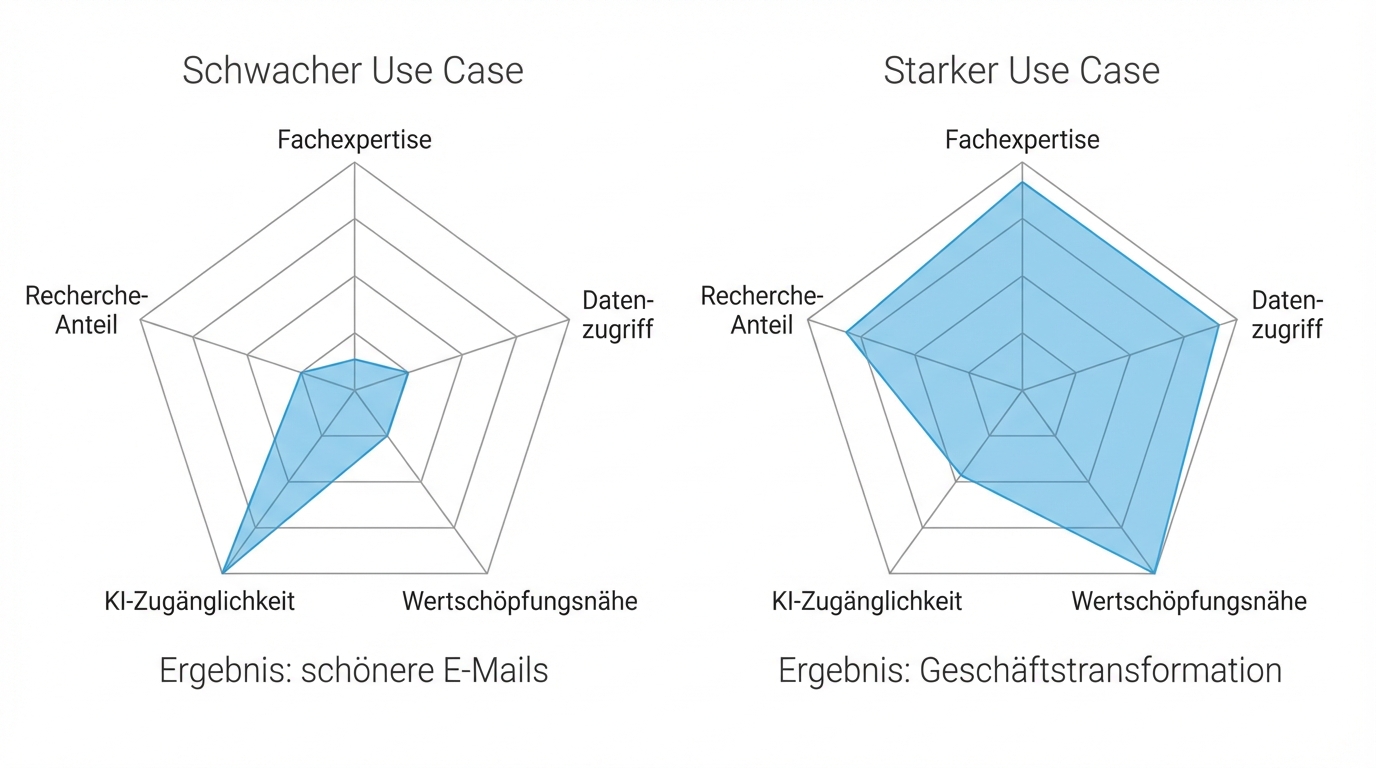
Across more than 27 AI projects, five characteristics consistently separate a value-creating use case from a nice gimmick:
Domain expertise in the process: The use case requires knowledge that isn't trivial. Not "summarise emails", but "evaluate tenders that require technical understanding". The more expert knowledge is embedded in the process, the bigger the lever.
High-quality data access: Not "big data", but the right data in sufficient quality. Ten well-answered tenders with the corresponding proposals are worth more than 10,000 unstructured documents. Data quality beats data volume.
Direct value contribution: The process has to sit close to value creation. Not internal slide decks, but the process that drives revenue, reduces cost, or frees up capacity.
AI accessibility: The problem has to be solvable by a language model. That sounds obvious, but isn't. If the task needs real-time data from physical sensors, or a decision no human can put into words, AI isn't the right fit.
Research component: The strongest use cases have a high share of searching, compiling, and reconciling information. That's where the lever is largest, because AI does exactly this kind of work faster and more thoroughly than any human.
At least three of these five criteria should apply. If all five apply, you have a candidate for a transformative project.
Start small, don't think small
The entry point doesn't have to be big. A concrete process, a clearly defined outcome, a budget in the five-figure range. Companies that start with one focused project reach productive results faster than those that first write an AI strategy for the entire organisation.
Why? Because most of what matters only shows up in the doing. What sounds logical on paper plays out differently in practice. The data looks different than expected. Domain experts raise requirements nobody thought of beforehand. Within two weeks, 30 iterations can be run and reveal things that planning alone would never have surfaced.
That doesn't mean the bigger vision is missing. The real compounding value comes when automation gains stack up across many processes, not just one. But the path there starts with the first successful project — the one that builds trust and proves it works.
Test in minutes, productive in weeks
A common misconception: AI projects are long and expensive undertakings. Reality looks different.
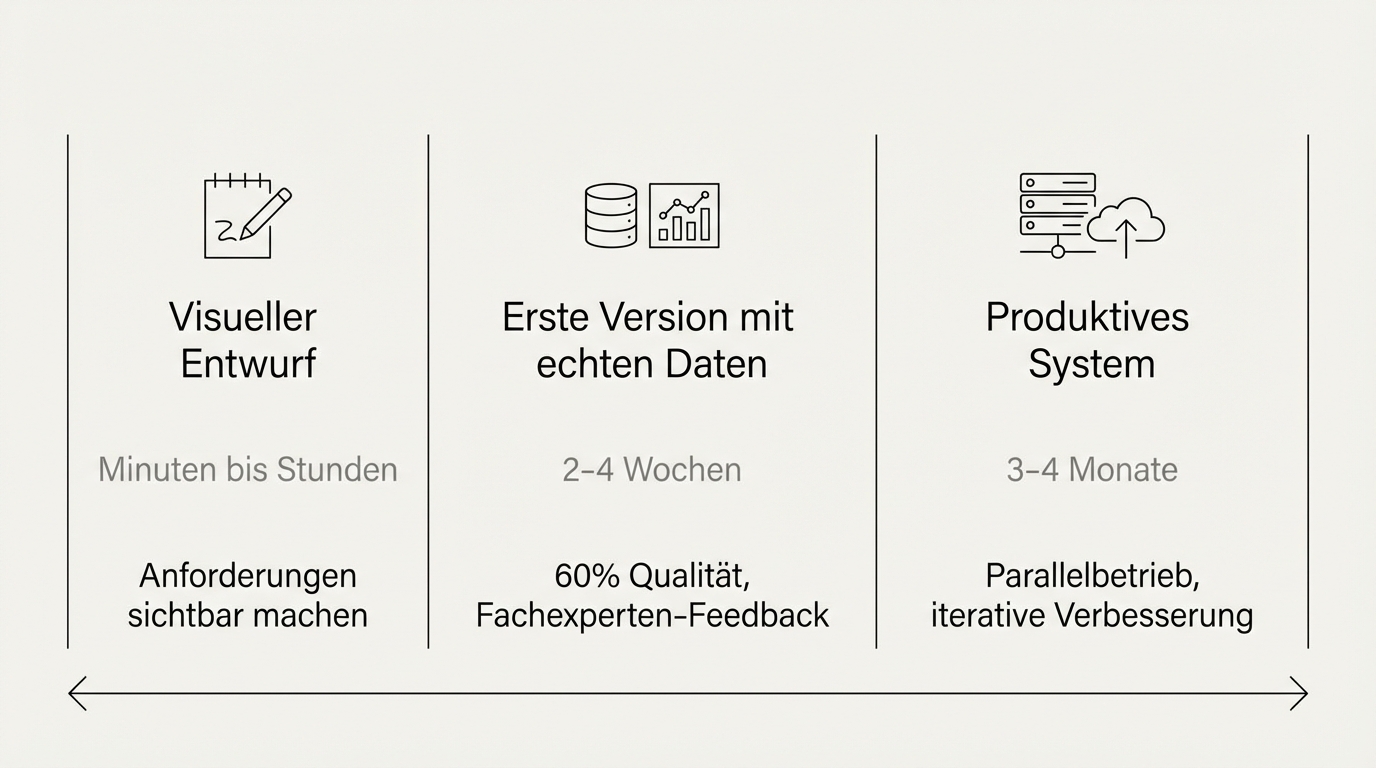
A visual prototype that captures the requirements of the department takes minutes to hours to build. Not as a slide deck, not as a concept paper, but as a working interface users can try out and evaluate. That removes the biggest uncertainty from the project: "Does our partner actually understand what we need?"
After that comes the actual work: connecting data, integrating processes, sharpening quality with domain experts. That takes weeks, not months. After three to four weeks there's a system working with real data and delivering first results. Not perfect results (those come with time), but results that immediately tell you whether the direction is right.
This works because we don't start from zero. In similar setups we've built proposal automation, document analysis, and knowledge extraction. The architectural patterns are in place. What changes is the domain knowledge — and that's exactly where we need your experts.
No risk: parallel operation instead of a system switch
The central promise we make every client: you can always fall back on the old process. No big bang, no ERP-style cutover cliff. The AI system runs in parallel to the existing process. If it works, you use it. If not, you continue as before.
In practice, it looks like this: the system drafts a result. Your domain expert reviews, corrects, approves. Every correction makes the system better, because it flows directly back into the optimisation loop. After a few weeks, correction effort drops noticeably. And parallel operation isn't double work: even if the system solves only 60 percent of cases well, you already save substantial time on those 60 percent.
What you need (less than you think)
Three things determine success or failure, and none of them is technology:
One person who truly wants it. Not "let's see what AI can do". Someone with decision authority who says: we are going to change this process. Without that determination, every project fizzles out after the first results.
A domain expert with four hours a week. The person who knows the process best. Who knows why things are the way they are, and who recognises when an AI output doesn't fit. Four hours a week at the start, one to two later. This investment has the highest return of the entire project, because it multiplies this one person's capability across the whole team.
Access to systems and data. Pragmatic and fast. The most common time sink in AI projects isn't development. It's waiting for access, approvals, and interfaces.
You don't need much internal IT capability. At minimum: a cloud environment we can work in, and secure access to the relevant systems. If you don't have in-house IT, we take care of hosting. On data protection, we provide the documentation your privacy counsel needs to review.
What it costs
A focused entry project typically runs between 15,000 and 40,000 euros. No license fees, no ongoing contracts. What we build belongs to you.
Running costs in operation: a few hundred euros a month for cloud infrastructure and API usage. Plus 15 to 20 percent of development cost per year for maintenance and updates.
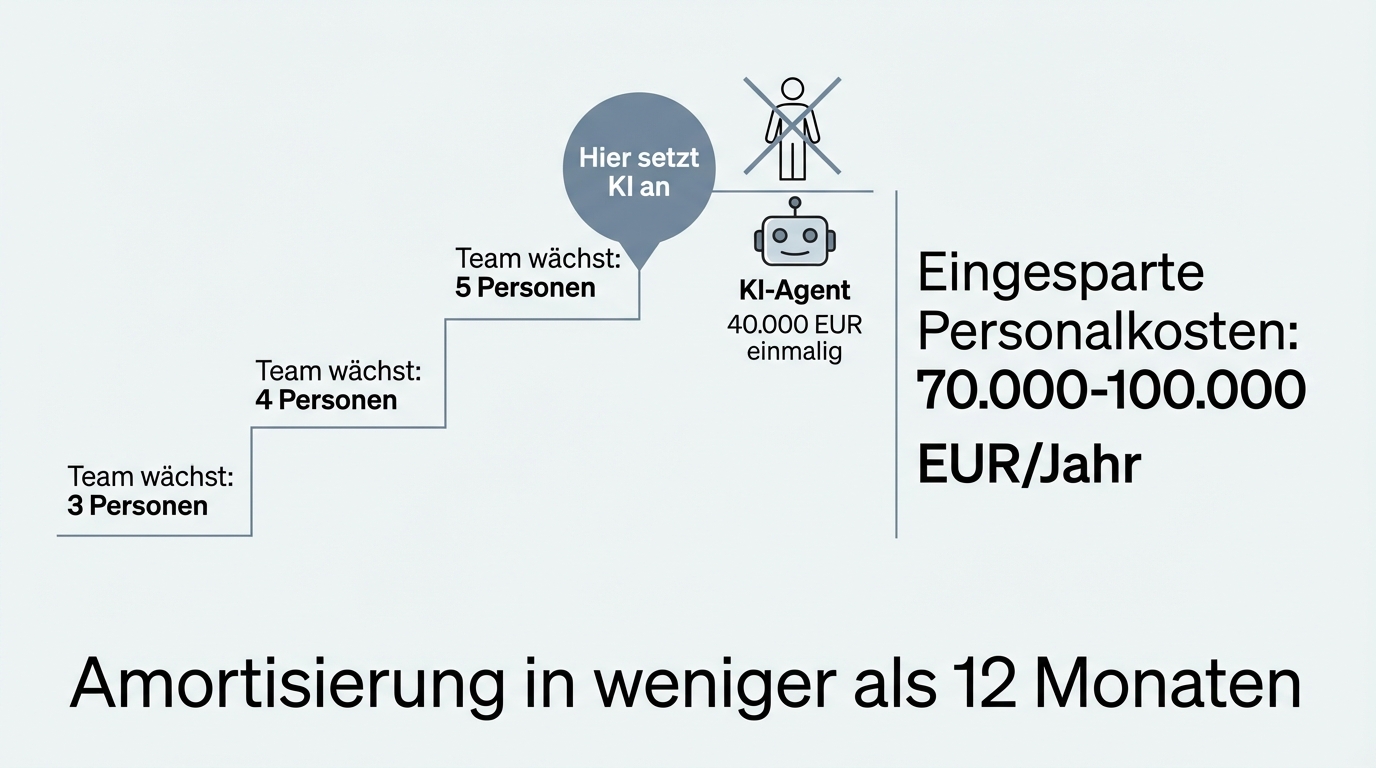
Payback rarely works through pure time savings. The real lever is scalability: if the existing team produces the same or more output without hiring another person, you save 70,000 to 100,000 euros in salary per year. With that, a 40,000-euro project pays for itself in less than a year.
The next step
We start with a conversation of 60 to 90 minutes. In that time we clarify: which process has the highest leverage? What data is available? Who is the right domain expert? Afterwards you'll know whether an AI project makes sense for your company, and can make an informed decision.
No strategy project, no consulting fee for the first conversation. Just an honest assessment of whether and how AI can create value in your case.