
Your sales team spends days working through 80-page enquiries, looking up part numbers in the ERP, and assembling proposals. Your best people, the ones who know which configuration fits which project, spend their time on copy-and-paste work instead of decisions.
That can change. Not someday, but now.
At a German industrial supplier handling several thousand proposals per year, more than half of all proposals now go out fully automatically. Another roughly 30% are prepared by AI and only corrected by the domain expert. Processing time per proposal, including review and sign-off by the domain expert: from two days to under thirty minutes.
The problem isn't the proposal process. It's the knowledge embedded in it.
Most companies think of software first when they hear "proposal automation": a tool that reads PDFs and fills in ERP data. But the real problem runs deeper.
Every proposal process contains decades of expert knowledge, distributed across several heads, undocumented in any manual, unrepresented in any software. The clerk knows that this particular client always gets a ten percent markup. The project manager knows that drives in wet areas need a different protection class. The sales director knows which custom configurations are worthwhile and which aren't.
This knowledge is implicit. It lives in your employees' heads, not in your systems. And that is precisely where AI-powered proposal automation starts: not with the technology, but with the transformation of implicit knowledge into explicit, measurable processes.
How it works in practice
The process doesn't start with an IT project. It starts with a concrete question: which proposals cost you the most time?
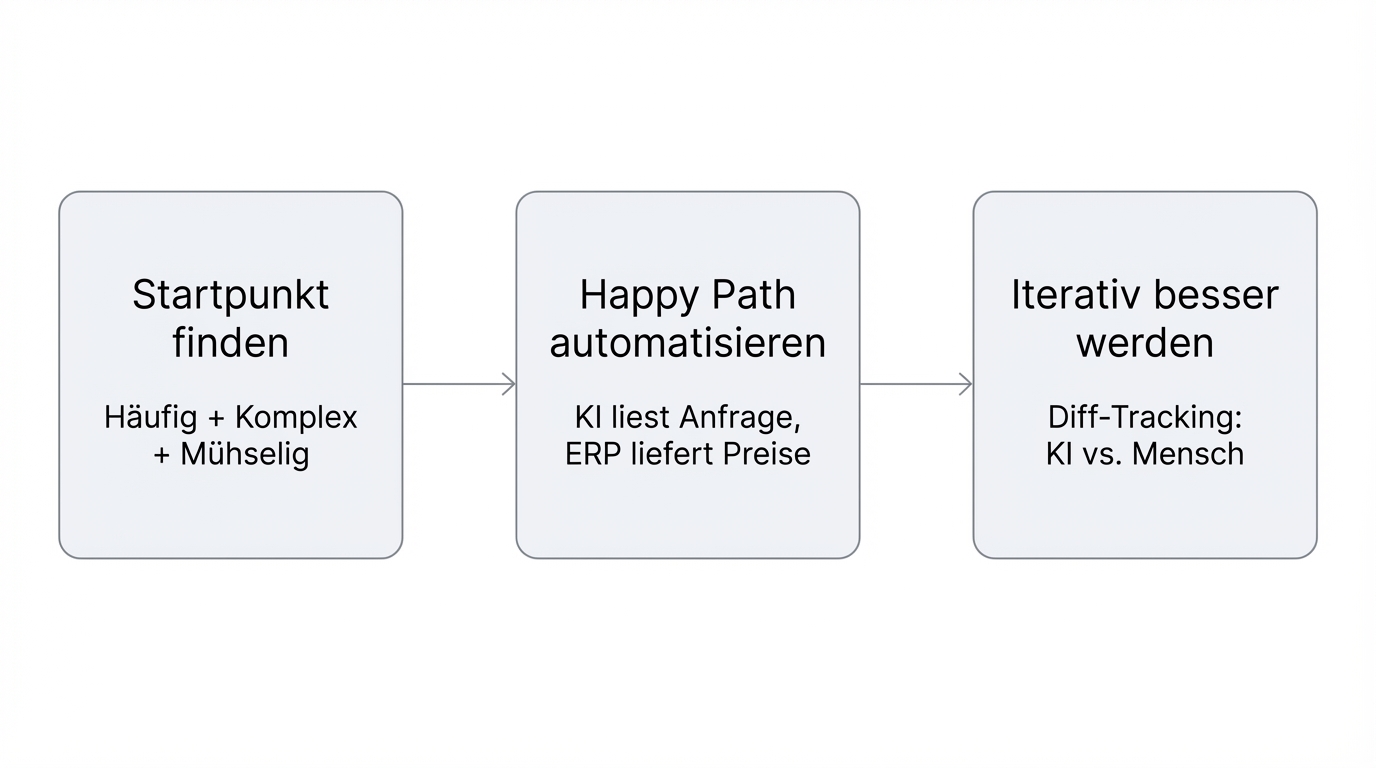
Step 1: Find the right starting point
Not every process is equally suited for automation. The best candidates meet three criteria:
- Frequency: The process runs regularly, daily, weekly, not once a quarter.
- Complexity: It requires combining information from multiple sources.
- Tedium: Your employees find it burdensome, hours of reading, copying, looking things up.
When all three criteria apply, you have an automation target that pays for itself in weeks, not months.
Step 2: Automate the happy path
We don't start with the most complicated edge case. We start with what happens most often and can be described most clearly.
An AI system reads the incoming enquiry, whether as a PDF, email, or tender document. It identifies the requested items, matches them automatically against your ERP system, and produces a pre-filled proposal. Prices and margins come directly from the ERP. The LLM never sees sensitive business data. It understands the enquiry; the ERP delivers the numbers. If information is missing from the enquiry, the system can ask the customer for it automatically. How we connect AI to ERP, CRM and document management is described on our page on AI integration for ERP, CRM and DMS.
In many cases, this works straight away. In others, it needs a correction. In a few, the manual path remains the right one. What matters is: even when the system gets it wrong, nothing bad happens. The worst case is the status quo: a human takes the conventional route.
Step 3: Improve iteratively
Every proposal a clerk corrects makes the system smarter. We measure systematically: what did the AI generate? What did the human change? And why?
This diff tracking, the comparison between AI suggestion and human correction, is the engine of improvement. It reveals where implicit expert knowledge is still missing. And it gives your domain experts a tool to externalise their knowledge step by step, without ever having to write a manual.
What changes, and what stays
Proposal automation changes the role of your employees, but it doesn't replace the right people.
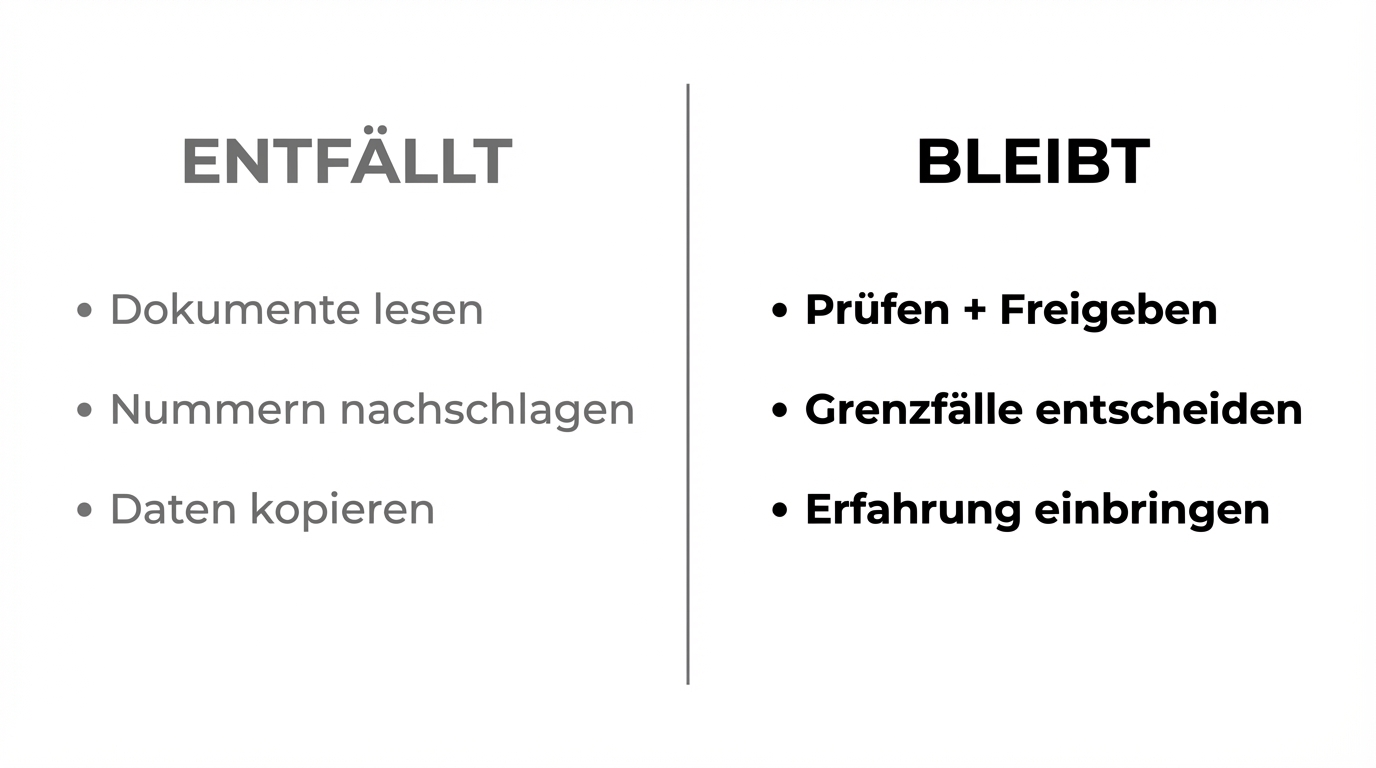
The manual work disappears: reading through documents, looking up part numbers, copy-pasting information. That's the part that consumed days and that nobody misses.
What remains, and becomes even more important, is accountability. The person who clicks "Send" at the end must be able to stand behind the proposal. They check whether the AI matched correctly. They decide on borderline cases. They bring the judgement that 20 years of industry experience creates.
In project management terms: the execution is automated. The accountability stays human. Your most experienced people don't become redundant. They are freed up for the work you actually hired them to do.
Why not off-the-shelf software?
The obvious question: why not just buy a ready-made tool?
Platform solutions exist. They provide the infrastructure: document intake, template management, versioning. What they don't provide: the adaptation work that makes the difference.
Because the hard part of proposal automation isn't reading a PDF or filling in a template. It's understanding that a "helical gear unit size 4" is a standard item, but a "helical gear unit size 4 with reinforced output shaft for reversing operation" is a custom item that needs to be engineered. It's knowing that food production plants always require stainless steel housings and FDA-compliant lubricants. It's recognising that an enquiry from the Netherlands has different customs terms.
No platform vendor can convey this knowledge during onboarding. It only emerges through direct collaboration with your domain experts, iteratively, over weeks, proposal by proposal.
Real numbers from practice
We have implemented AI-powered proposal automation for companies in plant engineering, refrigeration technology, the construction industry, and industrial manufacturing. The patterns are consistent:
| Metric | Typical result | |---|---| | Fully automated proposals | over 50% | | AI-assisted, manually corrected | approx. 30% | | Still fully manual | under 20% | | Processing time (before) | 1-2 days | | Processing time (after, incl. review) | 30 minutes | | First measurable result | 8-12 weeks |
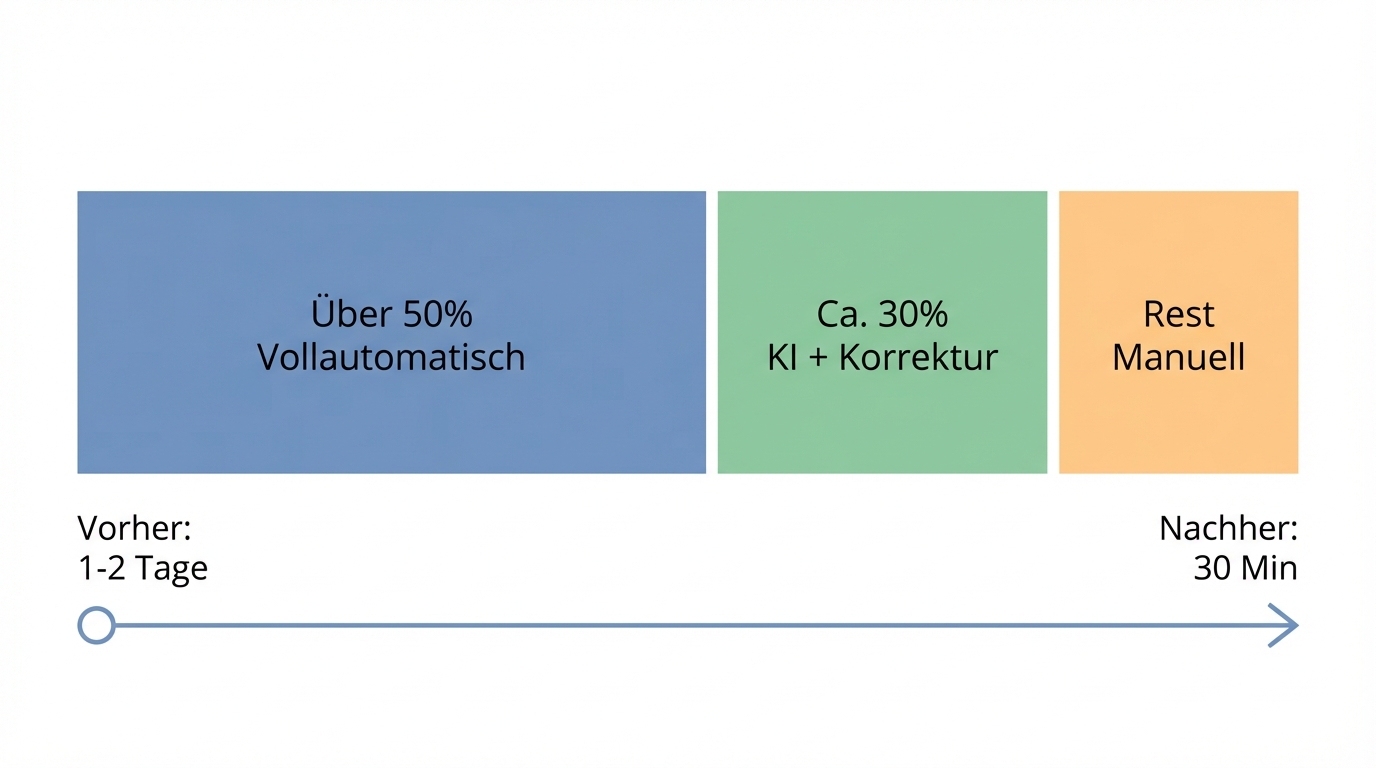
These numbers are not a promise but experience values. How high the rate will be for you depends on how standardised your enquiries and product portfolio are. What we can say with confidence: you will see within the first weeks whether and how well it works.
Who this works for
AI-powered proposal automation is particularly suited for mid-market companies with:
- High proposal volume, hundreds to thousands of proposals per year
- Complex product portfolios, configurations, variants, custom items
- An ERP system as the backbone, ProAlpha, SAP, Microsoft Dynamics, or comparable
- Incoming enquiries as the trigger, planner specifications, tenders, bills of quantities
One success factor that has nothing to do with technology: it takes someone at the top who takes this seriously. Not someone who "wants to see what AI can do," but someone who is willing to truly change the process.
The next step
We don't do pilot projects that end up in a drawer. We start with a specific proposal type, deliver a measurable result in eight to twelve weeks, and then decide together whether and how to continue.
If you'd like to know whether your proposal process is a good candidate: get in touch. We'll look at your typical enquiries and give you an honest assessment within a week.