
Your most experienced consultants spend hours writing proposals. They sit down after a client meeting, recall the conversation, search for old proposals as templates, draft the opening, the situation assessment, the approach, the milestones. Four to ten pages, starting from scratch every time.
The knowledge for a good proposal is there. It's just in the wrong place: in the consultant's head instead of in the system.
At consulting firms we work with, an AI system now generates roughly 70% of the first proposal draft. Consultants in multiple countries use it daily. Not as a novelty, but as a working tool.
Consulting proposals are different. So is the automation.
When someone hears "proposal automation", they think of item numbers, ERP lookups, and price lists. That works for industrial companies with standardised products. For consulting firms, the situation is fundamentally different.
A consulting proposal doesn't have a bill-of-materials core. It has an argumentative core: why this approach? Why this team? Why this experience? The text is the deliverable, not the packaging.
Three characteristics make consulting proposals distinct:
- Knowledge, not data: The relevant information lives in conversations, notes, and people's heads -- not in databases. 80% of proposals at a typical consulting firm are based on existing client relationships and personal conversations, not on formal tenders.
- Text, not configuration: A consulting proposal is a composed text: personal opening, situation assessment, objectives, approach, milestones. The final pages are standard language. The beginning and the scope demand deep contextual knowledge.
- Never fully automated: For product-based proposals, 60% can be ready to send. For consulting proposals, no proposal will ever go out fully automated. The professional scope is the consultant's core deliverable. AI prepares, the human decides.
That doesn't mean automation delivers less value. It means it works differently.
What the AI actually does: bringing context together
The biggest time sink in consulting proposals isn't the writing. It's the gathering.
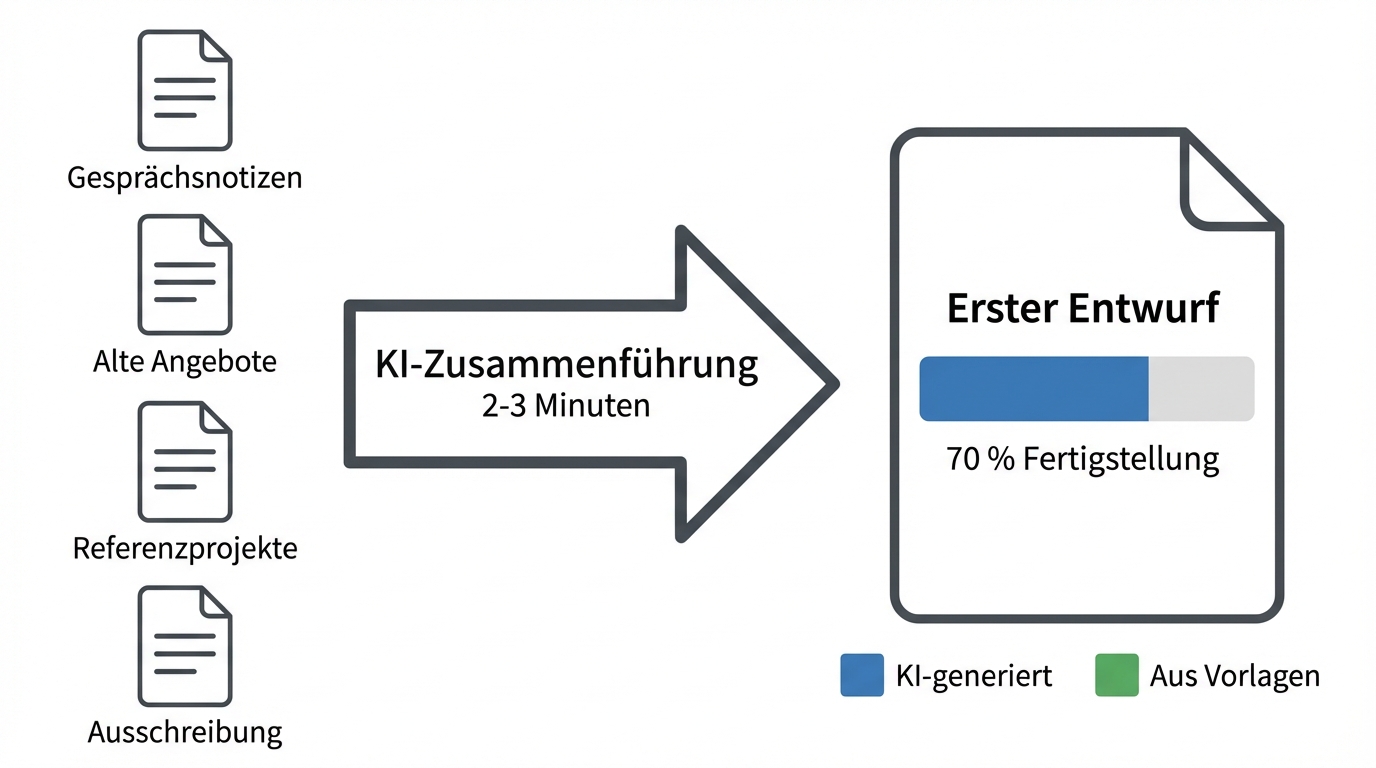
A consultant writing a proposal does the following: recalls the client conversation, searches for a similar old proposal as a template, looks up which reference projects fit, formulates the approach, brings everything into the right structure.
The real AI contribution isn't Word generation. The main value lies in bringing context together, translating it into a proposal structure, and enriching it with reference documents.
The system reads the incoming request or tender. It searches the archive of previous proposals for the best templates. It selects matching reference projects and case studies. It generates a complete first draft in the firm's tone and structure. Two minutes of generation. Then a Word document where colour coding shows what the AI wrote and what came from templates.
The consultant has an immediate starting point. Not a blank page, but 70% of a proposal they can correct, supplement, and approve.
The jump from "nothing at all" to the first usable draft is the biggest lever.
Two worlds, two approaches
Not every consulting firm needs the same solution. Size determines the path.
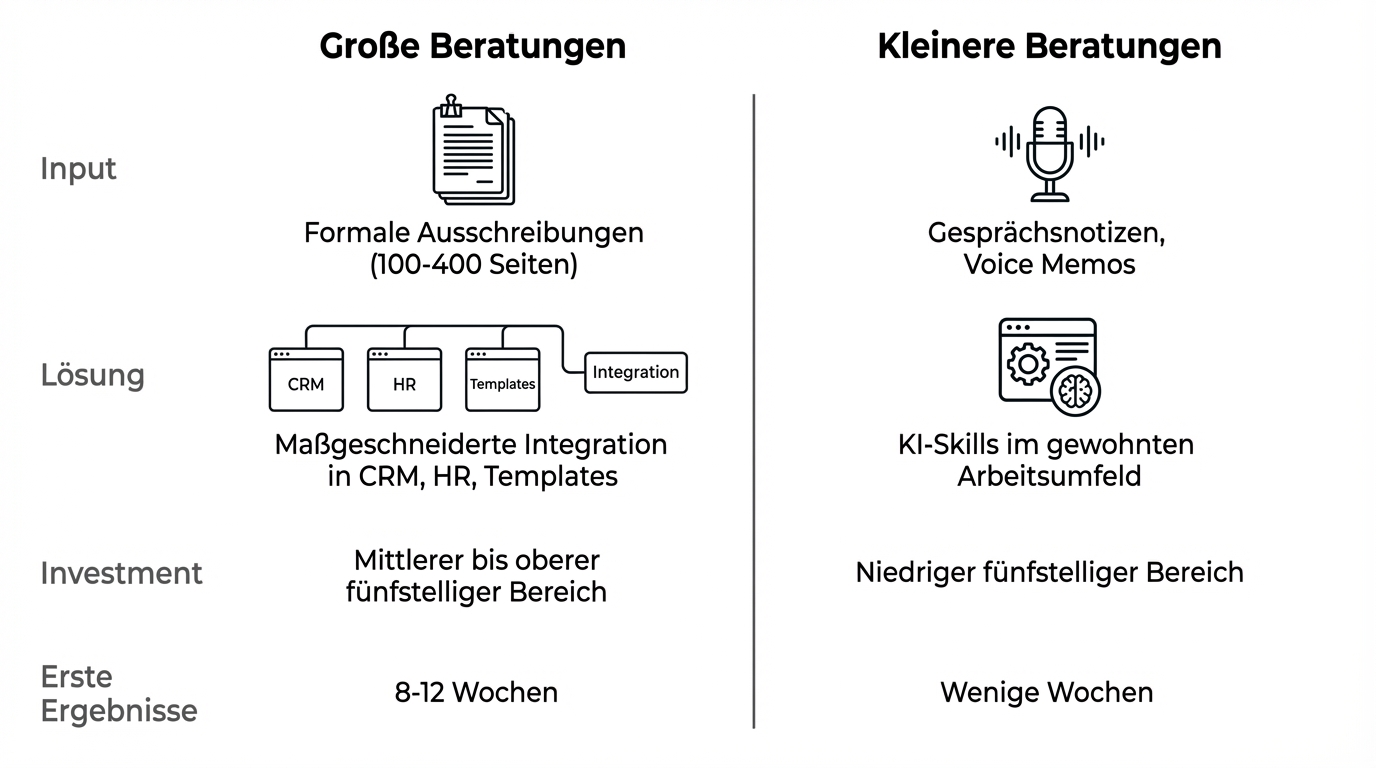
Large consultancies: custom integration
For consulting firms with several hundred consultants and formalised tender processes, a custom solution is the right approach.
The system integrates into the existing infrastructure: CRM, HR systems, reference databases. It pulls tenders from the systems where they already land. It accesses employee profiles and previous proposals. It generates directly into the Word templates that match the corporate identity.
The investment for such integrations typically falls in the mid to upper five-figure range. Clients see first measurable results after eight to twelve weeks.
Smaller consultancies: AI skills instead of a large-scale project
For consulting firms with 10 to 50 people, a comprehensive integration project isn't the right entry point. A different approach works here: targeted AI skills that support the proposal process without requiring dedicated infrastructure.
In concrete terms: a consultant comes out of a client meeting, speaks their notes into a microphone or types a quick brain dump. An AI skill takes that input, enriches it with old proposals and the firm's typical proposal structure, and delivers a first draft. Directly in Word, directly in the familiar working environment.
The investment is in the low five-figure range. First usable results come within a few weeks.
One thing, however, is identical in both worlds: it takes someone in the company who truly cares. Not someone who "wants to see what AI can do", but someone convinced that manual proposal writing wastes too much time.
What you need to get started: less than you think
No documentation project. No perfectly organised knowledge base. No thousands of curated references.
You need 5 to 10 historical proposals where the initial situation and the outcome are clear. That's enough to derive the first skill and initial capabilities.
The recommendation after that: just use the system. Write the eleventh proposal, look at what the AI produces, correct it, explain what should be different. Every correction makes the skill better. After 20 to 30 proposals, the system matches your firm's tone and structure.
The volume of historical proposals is irrelevant. What matters is the willingness to use the AI as a sparring partner and give it feedback.
What changes
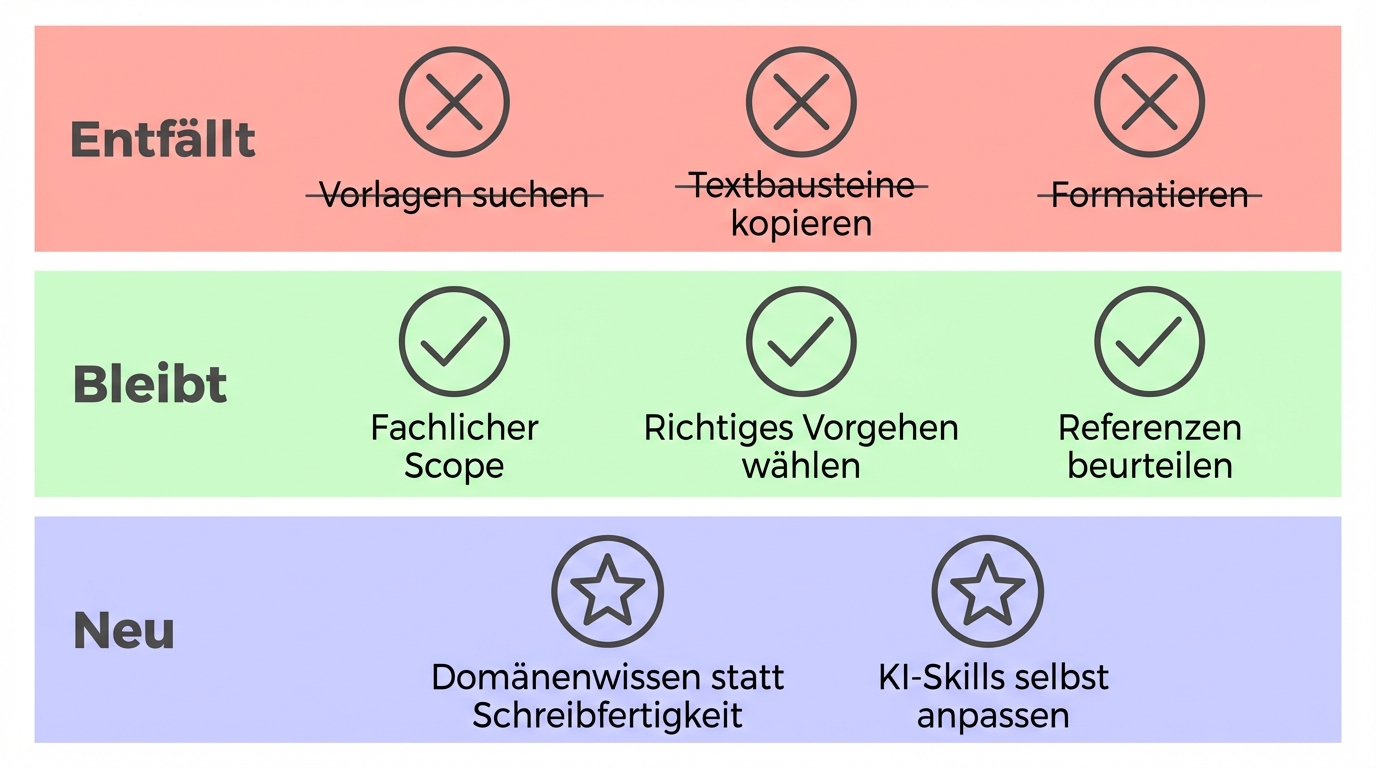
AI-powered proposal creation changes how your consultants spend their time.
What goes away: hours of searching for the right templates. Manually copying and pasting text blocks. Formatting work. These are the tasks that eat two hours per proposal and no consultant misses.
What stays: the professional decision about the scope. Choosing the right approach. Judging whether the suggested references fit. Everything that requires 15 years of industry experience.
What's new: a consultant who judges the quality of AI output doesn't need the skill of manual writing. They need domain expertise. And that's exactly what they can now focus on, because the formulation work falls away.
The AI skills -- the explicitly written rules by which the system creates proposals -- belong to you. We write the first version. Then we show your people how to adapt the skills themselves. In regular workshops, the knowledge is passed on. No dependency on the developer.
Experience-based benchmarks
| Metric | Large consultancy (formalised RFP process) | Smaller consultancy (conversation-based) | |---|---|---| | Completion rate of first draft | approx. 70% | 80-90% | | Generation time | 2-3 minutes | 1-2 minutes | | Post-editing time | Varies by complexity | 15-30 minutes | | Start to first result | 8-12 weeks | A few weeks |
The higher completion rate at smaller consultancies has a simple reason: fewer people involved, shorter feedback loops, faster iteration. Those who work closely with the AI and correct mistakes immediately reach high quality faster.
These figures are experience-based benchmarks, not guarantees. How high the completion rate will be for you depends on the complexity of your proposals and your team's willingness to actively improve the system.
Why not a platform solution?
The objection is obvious: in two years, my CRM vendor will have built this as a feature.
That objection underestimates where the real value lies. Platforms can provide tools. They can manage templates and generate documents. What they can't do: sit next to your domain experts and understand why a defensive tone works better for this client. Why this case study doesn't belong in the proposal despite the same industry classification. Why the approach for an existing client needs to be framed differently than for a new one.
That knowledge transfer -- from what your consultants know implicitly to what an AI system can apply explicitly -- is the real value. And it's different for every industry, every consulting field, every firm.
Platform vendors want standardised solutions that scale. The value of your proposals lies precisely in the fact that they're not standardised.
The next step
We look at your typical proposals and give you an honest assessment: where is the biggest potential? Which approach fits your size and your systems? And what can you realistically expect?
No slide deck. Instead, we take one of your recent proposals and show you live what an AI skill can do with it.