
Profiles are the biggest pain point in tenders. Not the second biggest, not one among many. In every client conversation we've had in recent months, profiles land at number one. With 60 to 70 pages of technical concept per tender phase and dozens of profiles that each need to be tailored to specific requirements, a proposal manager spends most of their time not on strategic work, but on writing.
That doesn't have to stay this way. AI can take over the bulk of that writing today. Not in theory, but in live systems delivering results every day. Screening and evaluating the tender documents themselves can be automated too, see our page on AI document analysis.
The human decides, the AI writes
The most important principle in automated profile creation: the strategic decision stays with the human, the writing is handled by AI. An international client put it succinctly: "We're not asking you to pick people."
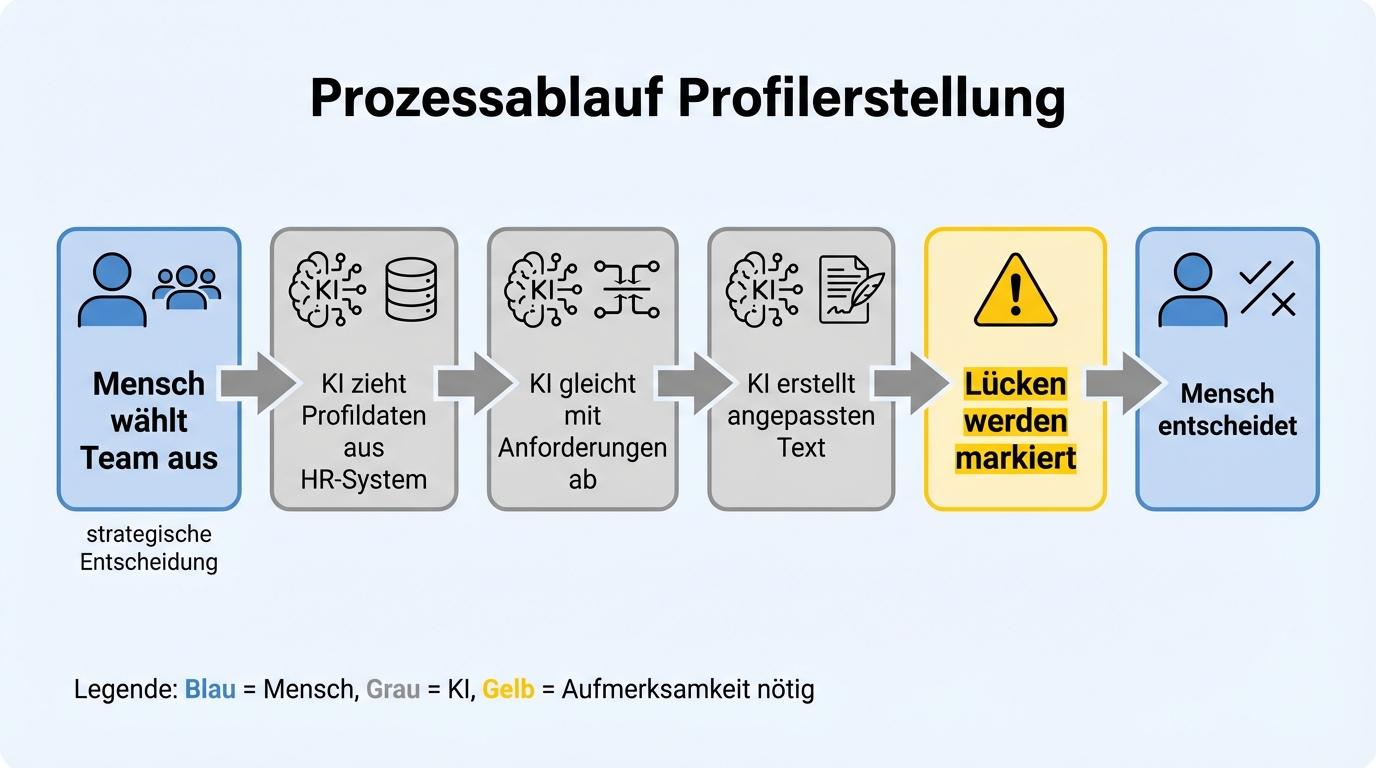
In practice it works like this: the proposal lead assembles the team and decides who fits the project. The AI then takes over the tedious work. It pulls current profile data from the HR system, matches it against the tender requirements, and creates a tailored profile text that highlights the relevant qualifications and experience.
The division of labour is deliberate: selecting people requires judgement, interpersonal understanding, and strategic thinking. Adapting profiles requires careful reading, rephrasing, and formatting. The former is a leadership task. The latter is writing work that AI completes in minutes where a person needs hours.
What happens when the tender requirements don't match the profile? Say ten years of Java experience are required, but the consultant has seven? The AI doesn't embellish. It flags the gap and shows options. The decision on how to handle the discrepancy stays with the proposal lead. That's not a technical compromise -- it's a design principle.
The HR system provides the foundation, not the project history
Where does the profile data come from? In most companies, structured employee profiles already exist in the HR system. Whether Workday, Factorial, or another system: the master data on qualifications, certifications, language skills, and work experience is the primary source.
Project history from previous proposals supplements this foundation. If a consultant already had a tailored profile in a similar project, that context flows in. But the base remains the HR system. This priority matters because HR data is structured, current, and company-wide consistent, while reference proposals can be outdated or incomplete.
What practice shows: profile data in HR systems is often imperfect. Sometimes outdated, sometimes patchy. But that's not a blocker. Outdated data becomes visible when the AI uses it in a concrete profile. The proposal lead corrects in the profile text, and the correction feeds back into the source system simultaneously. The AI doesn't demand a perfect data foundation as a prerequisite. It makes bad data visible and improves it through the work process.
For larger consultancies, there's an additional dimension: a consultant doesn't have one profile but several. Someone who works across four industries needs four industry-specific profiles. A proposal in resource extraction highlights different experience than a technology project. The architecture must support these facets. The simple variant -- one profile per person -- is contained as a special case.
Results in weeks, not months
How quickly can such a system deliver productive results? Experience from multiple projects shows a clear quality path.
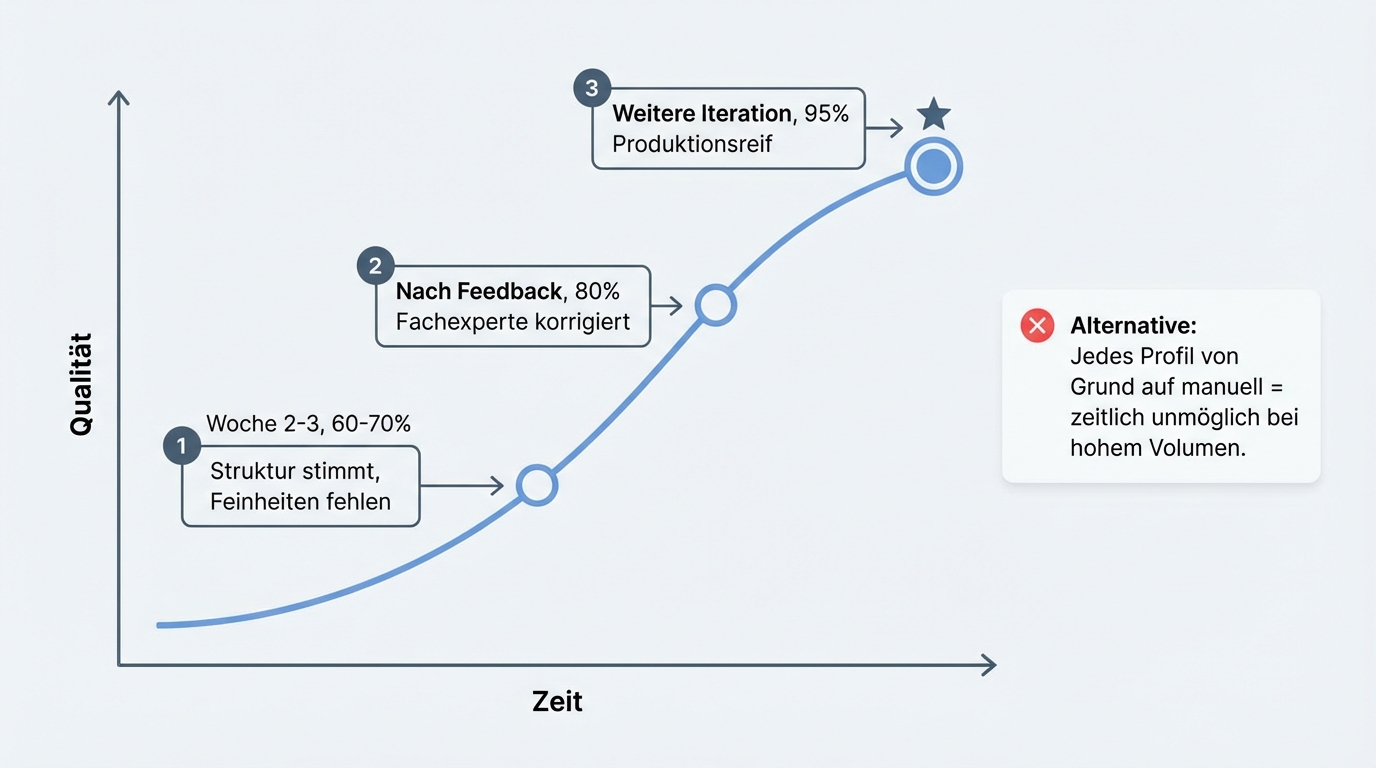
In the first two to three weeks after project start, initial test outputs emerge that typically reach 60 to 70 percent of the desired quality. That sounds low, but it means: the bulk of the structure, formatting, and content mapping is correct. What's missing are nuances that only the domain expert can judge.
Then the feedback loop begins. The domain expert in the company -- the person with the deepest knowledge of the firm's own capabilities and industry language -- provides targeted feedback. Where does the AI emphasise incorrectly? Where is context missing? Where is the phrasing too generic? After this iteration, quality rises to around 80 percent.
In a further round, the system typically reaches 95 percent. Not through magic, but through a defined process: the adaptation logic is controlled through prompts that the domain expert can evolve independently. The system improves with every piece of feedback because improvements are codified.
An important caveat: the 95 percent aren't automatic. They require a domain expert who actively runs the feedback loop, and they depend on the quality of that feedback. But the alternative -- writing every profile from scratch manually -- isn't 100 percent quality. It's simply impossible at high tender volumes.
Why off-the-shelf AI tools don't solve the problem
The obvious question: why not just use ChatGPT or Copilot to create the profiles? The answer: because the hard part isn't text generation -- it's integration.
Which documents are consulted in which order? How are HR data matched against tender requirements? What happens with implicit requirements that aren't stated verbatim in the tender but are taken for granted in the industry? None of these questions have a universal answer. The right configuration only emerges through collaborative work with the client.
Reasoning models have significantly improved the detection of implicit requirements in recent months. For everyday matching they deliver very good results. But for highly specific domain knowledge or trade secrets that aren't part of the model's base knowledge, they hit their limits. A broad benchmark dataset that is tested regularly becomes a valuable quality safeguard for unknown content.
For the foreseeable future at least, custom integration remains the decisive differentiator. The models keep getting better, but the competitive advantage from curated data, tested configurations, and lived domain expertise persists.
Three maturity levels for document output
How the finished profile reaches the proposal lead depends on the company's maturity level.
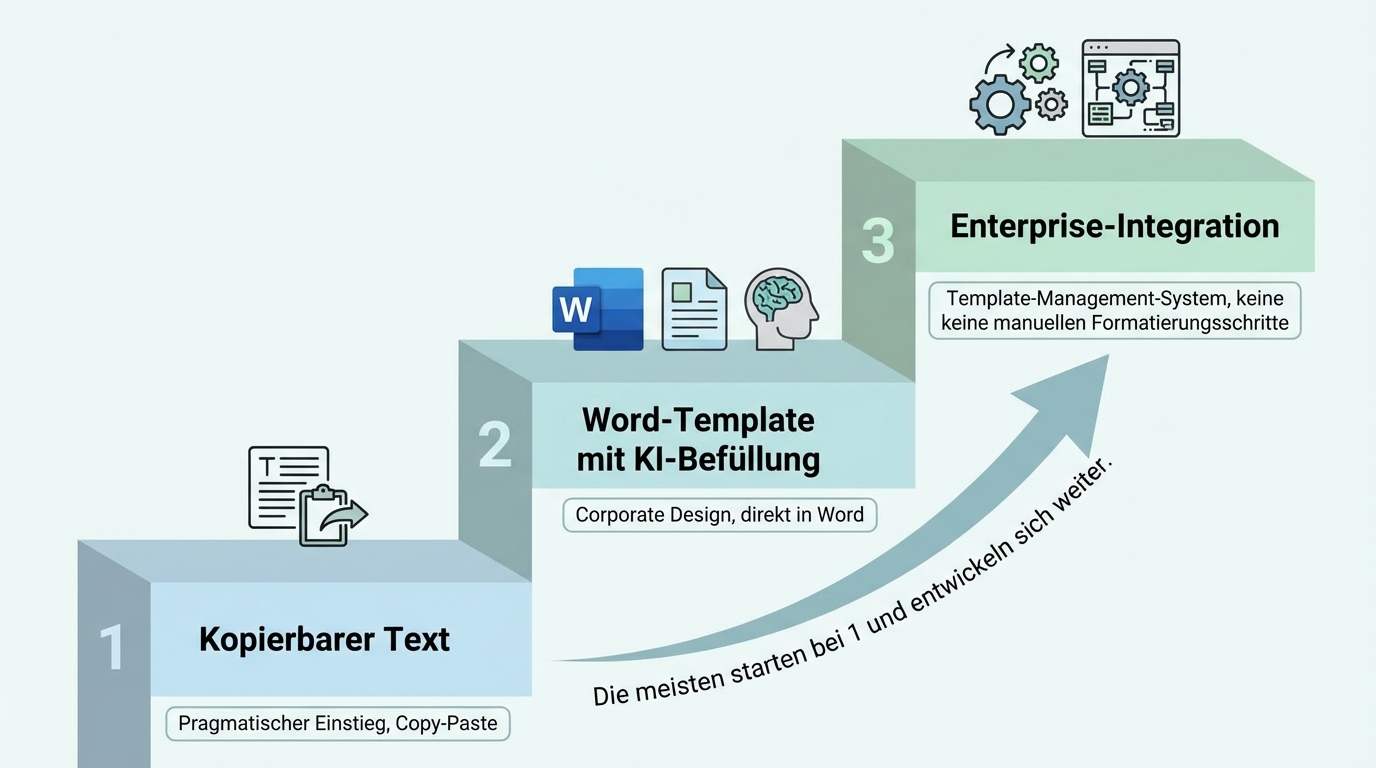
Copyable text in a web interface: The pragmatic entry point. The AI generates the tailored profile text, the proposal lead copies it into their proposal document and handles the final formatting. Minimal integration effort, full control over the end result.
Custom template with automatic population: The middle tier. The profile is inserted directly into a Word template that matches the corporate design. Colour coding shows which texts are rule-based and which are AI-generated. The proposal lead sees at a glance where they still need to intervene.
Enterprise integration with template management: For companies with high tender volumes. Profiles are fed into the existing document infrastructure through specialised template partners. This requires higher setup effort but eliminates manual formatting steps entirely.
Most companies start with tier one and progress once the system has proven its reliability. Promising something that works and then overdelivering is better than committing to something that fails five percent of the time.
One prompt per domain expert keeps the system manageable
A common objection: who maintains the adaptation logic when the system runs across multiple departments? Ten departments, ten different profile templates -- who keeps track?
The answer is a design rule: a prompt is scoped so that it needs only one domain expert. One prompt for technical qualifications, another for industry experience, a third for project references. Each is maintained by the person with the deepest expertise in that area.
Consistency isn't achieved through coordination among all stakeholders but through clearly defined handoff points between prompts. At those handoff points, quality parameters can be checked automatically. Within their area, each domain expert can work relatively freely.
What happens when the domain expert leaves the company? Compared to the pre-AI era, things are better: without AI, the adaptation knowledge lived only in the most competent person's head. Now it's explicit in the prompt and documentation. What is well documented for the AI is also comprehensible for a successor. In larger organisations, teams of several people are trained, with a documented guide for prompt management.
The next step
Bring a current tender where you need to create profiles. We'll show you what automated profile tailoring looks like applied to your specific requirements -- what data sources your system needs and how the quality path from 60 to 95 percent plays out realistically in your case. In 60 to 90 minutes, you'll have a clear picture of what can be automated and what stays with the human.