
In short: European language models do not currently match the quality of the leading US models. The decisive question is therefore not which provider, but through which channel you access the models: directly from the model provider with European data residency, via Azure with data centres in Europe, or via a routing provider. A model-agnostic architecture with RAG instead of fine-tuning ensures you can switch providers at any time.
IT managers and data protection officers face the same question: we want to use AI, but can we rely on a US provider? Are there European alternatives? What happens if the political landscape shifts?
The honest answer is uncomfortable: there are currently no European language models that can compete with the leading US providers. But the question is framed wrong. The real decision isn't "which provider" but "through which channel do I access the same models." And the architecture behind it determines whether a company stays dependent or can switch at any time.
European language models cannot keep up right now
This is not a temporary state but a structural reality. Open-source models that could run on your own servers are roughly eighteen months behind the state of the art. This assessment has remained unchanged over 18 months: the gap is not shrinking, it's stable.
That means: if you want leading quality, you cannot avoid the commercial models from the major providers. OpenAI, Google (Gemini), and Anthropic (Claude) deliver the models that produce the best results in practice, especially for complex tasks that require reasoning and multi-step processing.
That doesn't mean on-premise solutions are pointless across the board. For simple tasks like internal document search, meeting transcription, or straightforward knowledge queries, open-source models can be sufficient. But for demanding domain questions, iterative data queries, or tasks that require genuine "thinking" from the model, you need the leading models. The decision is: leading quality or full control over the infrastructure. Both at once is not realistic today.
The real question: procurement channel, not provider
If the major providers' models are the best choice, the next question is: how do I access them?
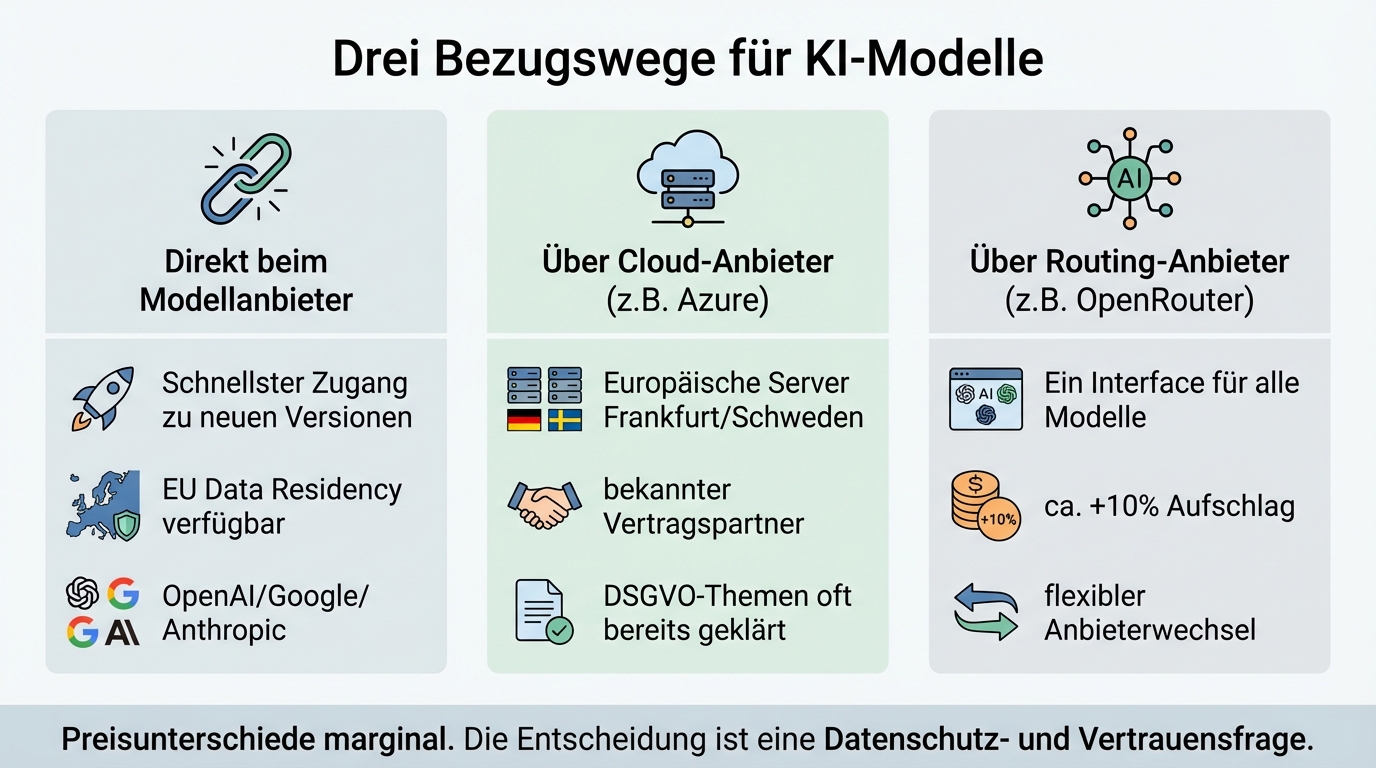
Three channels are available:
Directly from the model provider. OpenAI, Google, and Anthropic offer API access to their models. OpenAI now also offers European data residency for business customers without requiring an enterprise agreement. Direct access is typically faster for new model versions and offers better availability.
Through an established cloud provider. Microsoft Azure hosts the OpenAI models on European servers, for example in Frankfurt, Sweden, or Switzerland. Google Cloud offers something similar for Gemini. The advantage: the data processing agreement says "Microsoft" or "Google," not "OpenAI from San Francisco." For companies with sensitive stakeholders, that can make the decisive difference.
Through specialised routing providers. Services like OpenRouter bundle access to various models through a unified API. The surcharge is around 10 percent on API costs. The advantage: a single contract, a single interface for all models, and with some providers the option to select European servers.
Price differences between these channels are marginal. OpenAI direct and Azure have very comparable costs. The channel question is a data protection and trust question, not a cost question. On-premise is structurally more expensive due to underutilised hardware, high energy prices, and fixed operating costs.
European providers and open source: when they fit
Besides the three channels for the leading models, two further options come up regularly in data protection discussions and tenders.
European model providers. The best known is Mistral AI from France. For clearly defined tasks such as classification, summarisation, or extracting information from documents, European models often deliver usable results. For complex domain questions that require multi-step reasoning, they lag behind the leading models from OpenAI, Google, and Anthropic in our experience.
Open-source models with European hosts or on your own hardware. European cloud providers run open models in their own data centres and offer them via API. Alternatively, they run on-premise in your own server room. That gives you maximum control. The price is quality, which lags around a year and a half behind the state of the art, and, for on-premise, the fixed costs of hardware and operations.
In practice, this means: European and open models are not a full replacement for demanding tasks, but they are a sensible complement. A model-agnostic architecture lets you combine both worlds: a European or self-hosted model for simple, high-volume, or particularly sensitive steps, and a leading model via a European channel for the demanding ones.
Azure is often the politically smarter choice
From a purely technical standpoint, direct API access from the model provider would be the best option: faster for new versions, better availability, fewer intermediate layers. But technology isn't everything.
20 to 30 percent of stakeholders in German companies react strongly to the name in the data processing agreement. "OpenAI Limited, San Francisco" triggers discussions, regardless of whether the data is actually processed in the US. "Microsoft, Frankfurt" doesn't trigger those discussions, because most companies already have an established business relationship with Microsoft and have long since resolved GDPR matters with the corporation.
For companies with high confidentiality requirements, Azure is therefore often the more pragmatic recommendation, even though it comes with a small technical drawback. The name in the data processing agreement is a real factor in internal and external communication.
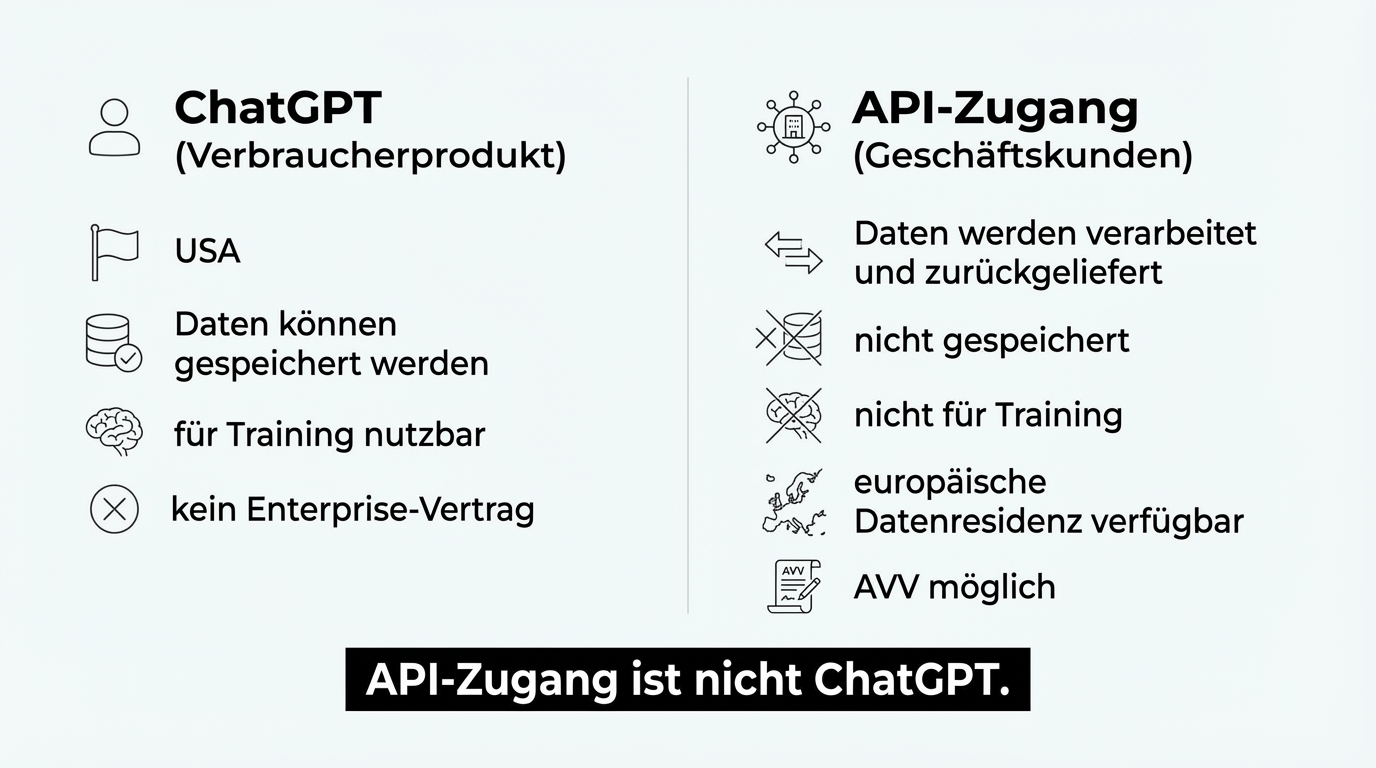
Important to note: Azure-hosted models are not ChatGPT. The ChatGPT application runs in the US and is a consumer product. API access to the underlying model (GPT) via Azure is something entirely different: a GDPR-compliant service where data stays in the chosen region and is not used for model training.
Model agnosticism is not a theoretical safeguard but lived practice
The fear of depending on a single provider is justified. The solution is not to fall back on weaker alternatives, but to adopt an architecture that makes the provider interchangeable.
The principle: the actual software is decoupled from the model. The language model is a replaceable module connected through a standardised interface. Whether GPT, Gemini, or Claude runs behind it is a configuration question, not an architectural problem.
In practice, roughly half of all projects run directly through OpenAI, the other half through Azure. Some clients use different models from different providers depending on the task. And yes, models have been switched in running projects. With well-written configurations, switching a model takes one to two weeks of adjustment work, specifically on the content side (optimising prompts), not on the technical side.
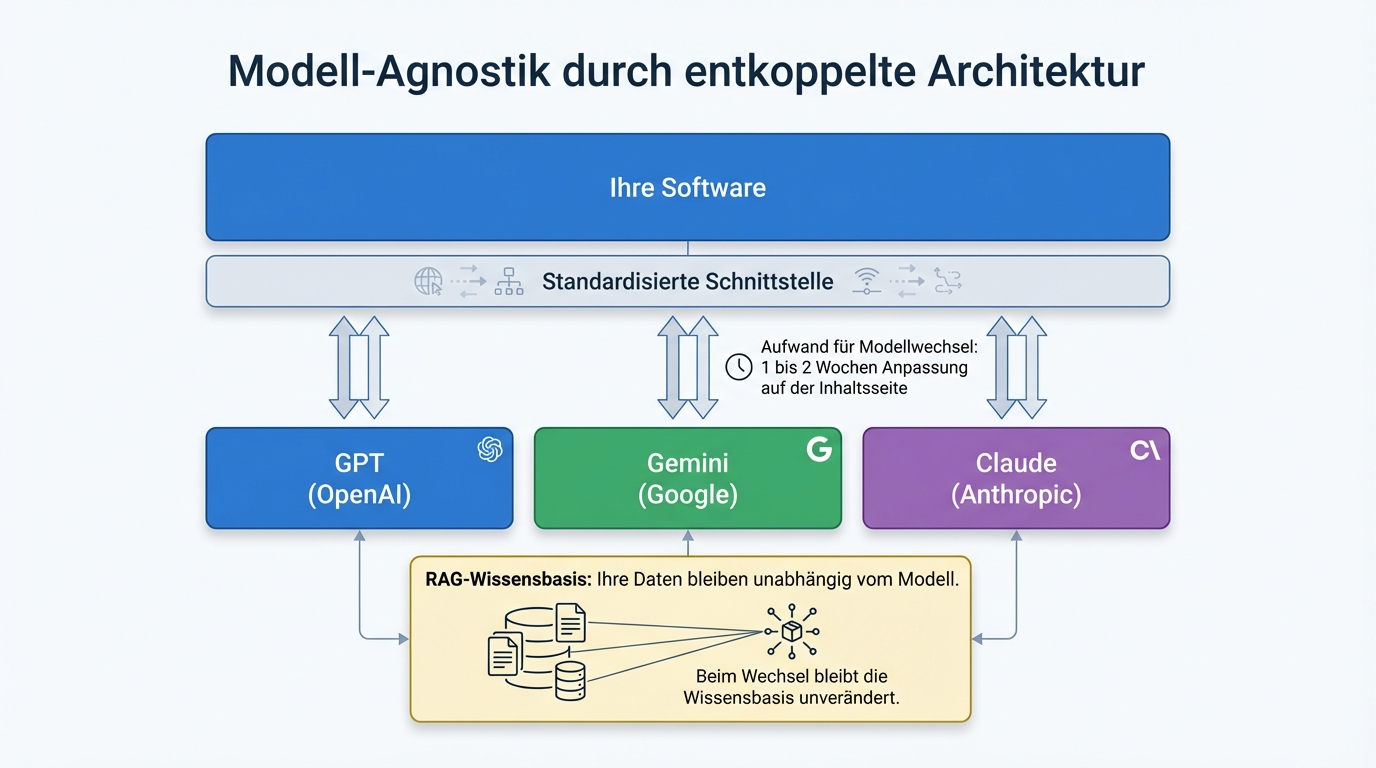
This model agnosticism is also a risk strategy: if trust in a provider is lost, whether through a data protection scandal, a price increase, or a political decision, switching is possible at any time. No vendor lock-in, no existential dependency. This is also what to look for when choosing an AI service provider: they should not hard-wire a single vendor.
RAG instead of fine-tuning: the architecture that enables independence
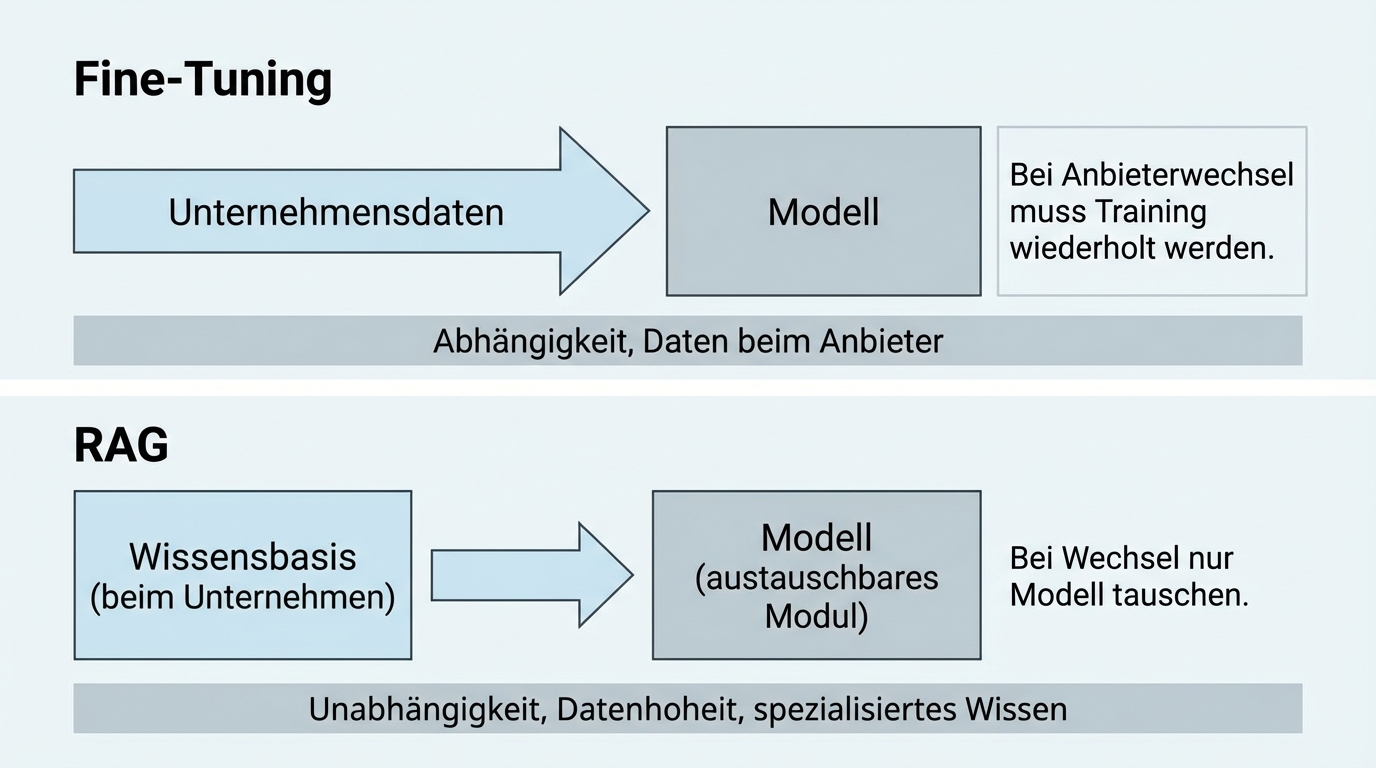
The key to model agnosticism lies in the architecture. Instead of retraining a language model with your own data (fine-tuning), a RAG architecture is used: your own data stays in a separate, searchable knowledge base. With every query, the relevant information is retrieved from this knowledge base and passed to the model as context.
Three advantages that relate directly to the provider question:
No dependency on the model vendor. With fine-tuning, the model itself is modified. If you switch providers, you have to repeat the training. With RAG, the knowledge base remains unchanged; only the model is swapped.
Data sovereignty stays with the company. Your own documents are not sent to the model provider to be incorporated into training. They remain in your own infrastructure or with a chosen host.
Specialised knowledge without retraining. The RAG architecture delivers validated domain knowledge with traceable source references. ChatGPT doesn't know your internal regulations, unpublished assessments, or company-specific processes. A RAG system does.
As models evolve, RAG and the new reasoning capabilities work together: RAG provides the context, the reasoning module operates on it. Interchangeability is preserved because the core capabilities (reasoning, automated tool use) are present across all two to three leading providers.
What "GDPR-compliant" means in practice
The GDPR debate around AI solutions is often emotional rather than factual. Three points bring clarity:
API access is not ChatGPT. When you use a model provider's API, you send data to a service that processes it and returns the result. The data is not stored and not used for training. That is a fundamentally different operation from using ChatGPT as a consumer product.
European data residency is available. Both Azure and OpenAI Business now offer the option to process data exclusively on European servers. The restriction that this required an enterprise agreement has been resolved by market developments.
Self-hosting is not a security advantage. Those who argue that on-premise is more secure are assuming their own IT security team is more competent than those of the major cloud providers. For most mid-market companies, that is a questionable assumption. The most trustworthy option is often the cloud provider you trust most, combined with an architecture that allows switching at any time.
How to build data protection into the architecture from the start, from server region to the chain of data processing agreements, is covered in GDPR-compliant AI is an architecture decision.
What the decision requires
Choosing a model is not an existential decision. It is a pragmatic trade-off that can be made in two weeks. Three questions are enough:
How sensitive are your stakeholders? If 20 percent of your members, clients, or employees react to "OpenAI, San Francisco" in the data processing agreement, choose Azure or a European host. The technical disadvantage is minimal, the political advantage substantial.
How complex are your tasks? For simple document search and transcription, on-premise may suffice. For domain questions with reasoning, multi-step processing, and automated tool use, you need the leading cloud models.
How important is independence to you? A model-agnostic architecture with RAG instead of fine-tuning gives you the freedom to switch providers at any time. It costs no more to build but secures you against long-term dependency.
Frequently asked questions about OpenAI alternatives
Is there a European alternative to OpenAI?
Yes, for example Mistral AI from France, or open-source models that European hosts run in their own data centres. They are often sufficient for simple tasks, but do not currently reach the quality of the leading US models for complex domain questions. The more pragmatic route is usually to use the leading models via a European channel, for example via Azure in an EU data centre.
Is using OpenAI GDPR-compliant?
API access can be used in a GDPR-compliant way if European data residency is selected and a data processing agreement is in place. Data submitted via the API is not used to train the models. The consumer product ChatGPT is a different matter and not the right route for confidential company data.
What is the difference between OpenAI and Azure OpenAI?
They are the same models. With Azure, Microsoft runs them in its own data centres, for example in Frankfurt, Sweden, or Switzerland, and Microsoft is your contractual partner. New model versions usually appear a little earlier with direct access, and the costs are very similar. The main difference is the name in your privacy policy.
Can you host a language model yourself?
Yes, with open-source models on your own hardware or with a European host. For internal document search, transcription, or simple knowledge queries, that can be enough. For demanding tasks, the quality is lacking, and operations are structurally more expensive than the cloud because of underused hardware and fixed costs.
How much effort does it take to switch AI providers?
With a model-agnostic architecture and RAG instead of fine-tuning, the effort is one to two weeks. The work is mainly on the content side, refining prompts and wording, not on the technical side.
Who can help choose the right AI procurement channel?
Deyan7 builds AI solutions model-agnostically by default. Roughly half of our projects run directly via OpenAI, the other half via Azure. We recommend the channel that fits your data protection requirements and stakeholders, and keep switching possible. What such a project costs is covered in What does an AI project cost?
The next step
Which channel is right for your company can be clarified in one conversation: How sensitive are your data and stakeholders? Which tasks should AI take on? Which cloud contracts are already in place?
Afterwards you'll have a concrete recommendation for model, channel, and architecture, without committing permanently to one provider.