
In short: AI products based on curated expertise are best monetized with a freemium model: a free allowance to try it out, then a subscription with practically unlimited questions in three tiers. You charge for access, not for individual questions. The most important metric is recurring usage, and the pricing model is fine-tuned during operation.
A company has spent years building domain expertise: training materials, technical publications, expert interviews, practical guides. Until now, access was tied to physical formats: seminars, books, consulting sessions. Now this knowledge can be made accessible as an AI-powered product: an expert chatbot that draws on curated sources and delivers well-founded answers with traceable references.
The technical implementation is solvable. The harder question is the business model: How much is free? What does full access cost? How do you prevent free alternatives from undermining your price?
Let them try for free, then charge
Nobody buys an AI product they haven't tried. The entry point must be free so that users experience the answer quality before making a purchase decision.
The principle is comparable to a tasting: you try it, confirm the quality is there, and buy. The cost of free uses is borne by the operator as a marketing expense. For an AI assistant with a curated knowledge base, these costs are in the cent range per query.
The number of free uses is a lever that can be adjusted during live operation. The benchmark: enough to recognise the quality, but not enough to fully cover the need. If all users exhaust their free allowance, it's too low. If nobody ever pays, there's no compelling reason to upgrade.
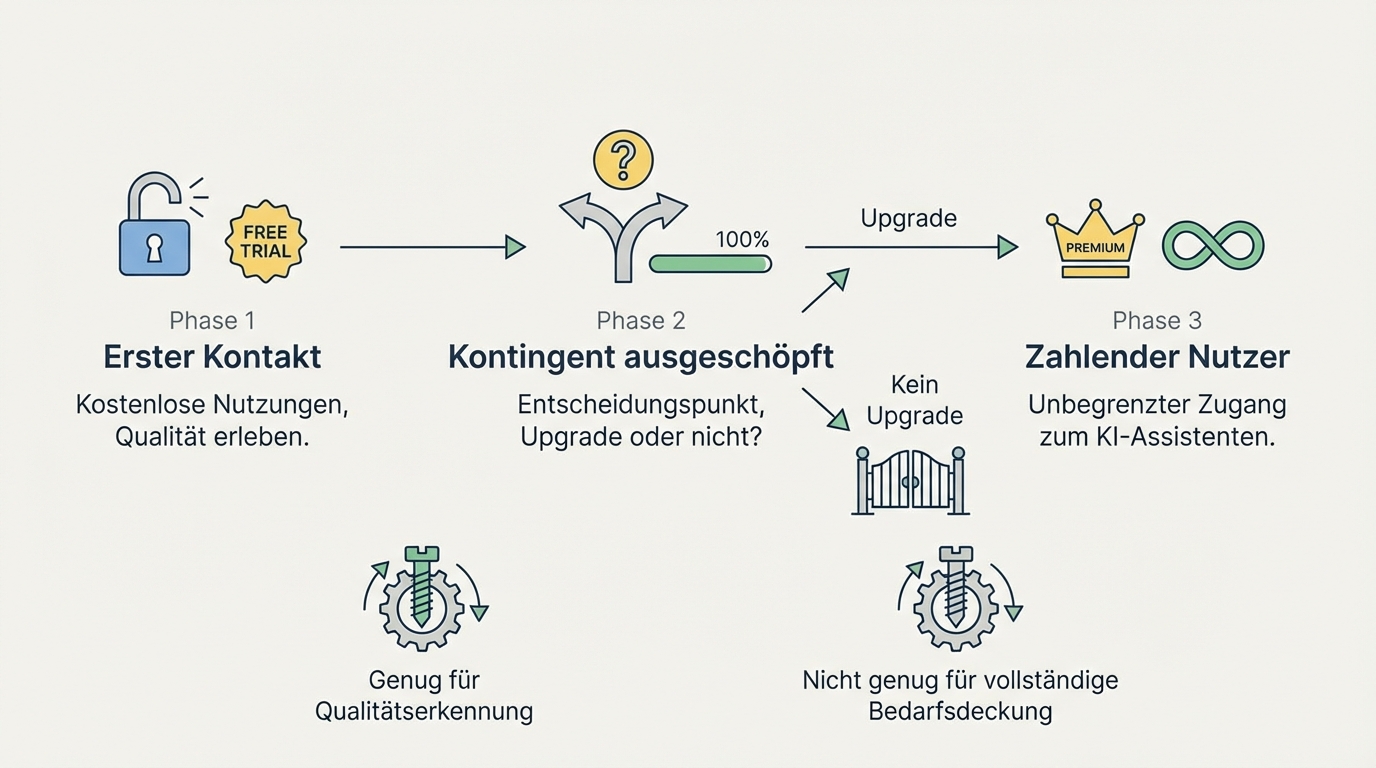
Unlimited questions, pay for premium access
One of the most important decisions: Should users pay per query or for access overall?
Paying per query inhibits usage. If every question costs money, users think twice before asking. That contradicts the goal of having users engage intensively and thereby recognise the value. Poorly worded questions that require a follow-up feel like wasted money.
The better approach: questions are included in the package price and practically unlimited. A fair-use limit protects against abuse but is set high enough that a normal user never reaches it. Paid add-ons are clearly delineated individual values: access to a complete training recording, the download of a practical guide, an in-depth expert report. These have standalone value that goes beyond "an answer to a question".
Three tiers, the middle wins
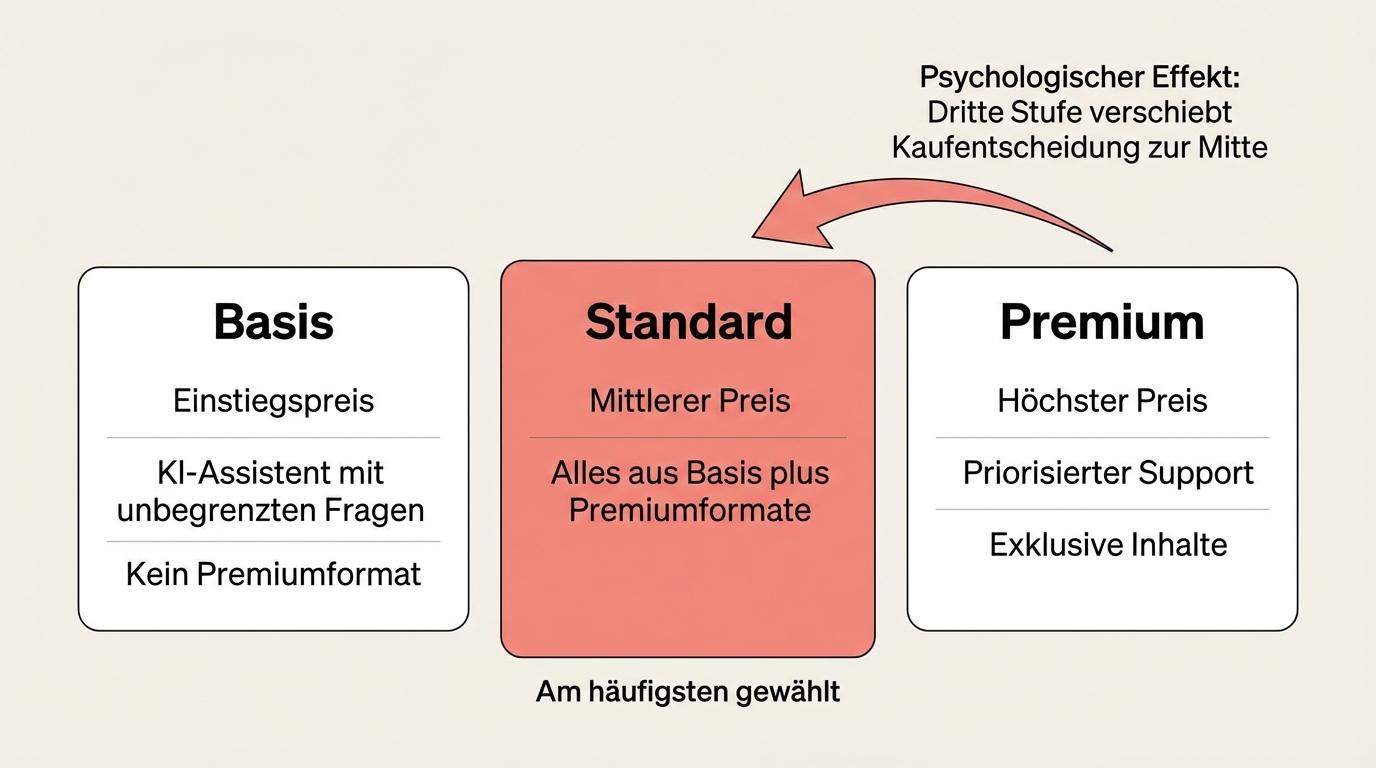
The pricing structure follows a proven pattern: three tiers, with the middle one chosen most often.
Basic: Entry-level price, access to the AI assistant with practically unlimited questions. Covers the core needs. No access to premium formats.
Standard: Mid-range price, everything from Basic plus access to premium formats (training sessions, guides, in-depth content). The right scope for the majority of users.
Premium: Highest price, additional features such as priority support, exclusive content, or extended usage rights. For power users and organisations.
Psychological pricing works: with only two packages, most people choose the cheaper one. As soon as a third, more expensive tier exists, the purchase decision shifts toward the middle.
Integrate new features into existing offerings
Not selling AI features as a standalone product but integrating them into existing offerings has proven the most effective strategy.
An example: a provider of professional training adds an AI assistant to its seminar offering. After the training, participants can ask questions about the content, look up sources, and deepen what they've learned. The training price rises slightly, the perceived added value rises significantly. No separate purchase decision is needed; the user automatically comes into contact with the AI product.
New capabilities (AI-generated summaries, thematic research across multiple sources, automatically created job aids) are integrated into the higher-tier packages rather than offered individually. This creates reasons for upgrades and keeps product complexity low.
For associations and membership organisations, the same principle works through membership: members get the assistant as part of their fee, non-members can test it with a free allowance. The assistant becomes an argument for membership and an acquisition tool at the same time.
What operation costs and what that means for pricing
The running costs of an AI assistant are manageable and easy to calculate. They have two parts:
Cost per request. Every question triggers calls to a language model. For an assistant with a curated knowledge base, these costs are in the cent range. They rise with the length of answers and the number of sources evaluated per question.
Fixed operating costs. Hosting, knowledge base, and monitoring are incurred regardless of usage. In our experience, infrastructure costs between 50 and 300 euros per month. On top of that comes content maintenance: new publications have to be added, outdated ones removed.
Two rules for pricing follow from this. First: the price is based on the value to the user, not on costs. Someone who saves ten minutes of expert research with one answer compares the subscription price with their working time, not with API costs. Second: the fair-use limit protects the calculation. It is set so high that a normal user never reaches it, but it prevents individual accounts from firing off thousands of automated requests.
What it costs to develop such an assistant is covered in What does an AI project cost?
Why free generalists are no real competition
The obvious concern: "Why would anyone pay for our AI product when ChatGPT is free?"
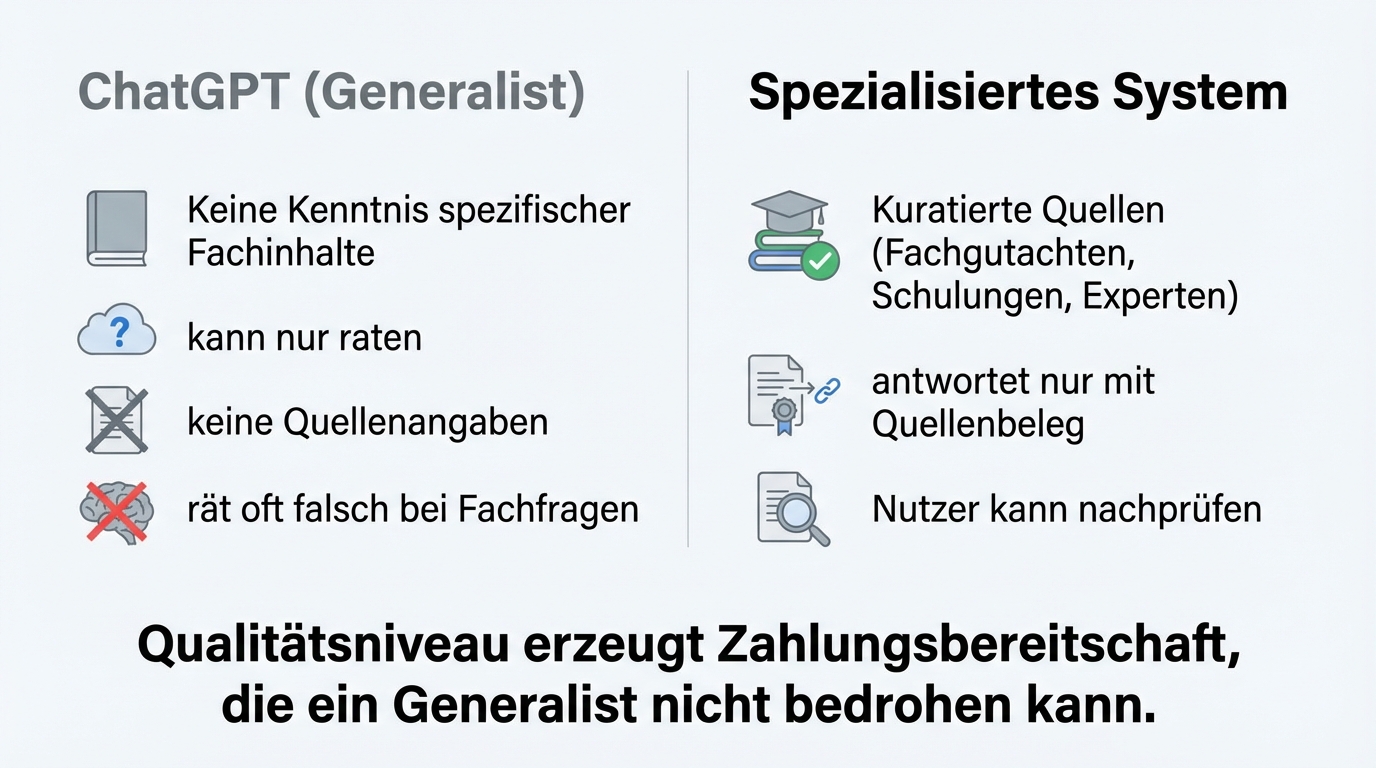
The answer lies in the source of the answers. A general-purpose language model has no knowledge of a company's specific technical content, the interpretation of particular regulations, or the recommendations from the latest expert training. It can only guess, and it often guesses wrong.
A specialised system is built on curated sources: technical articles by recognised experts, training materials, expert reports, practical guides. It only answers when a source covers the question, and it cites that source. The user can verify the answer and see where the information comes from.
This level of quality creates willingness to pay that a free generalist cannot threaten. Comparable systems have been processing tens of thousands of queries per month for over a year. Users come back because the answer quality is right.
Measure what matters
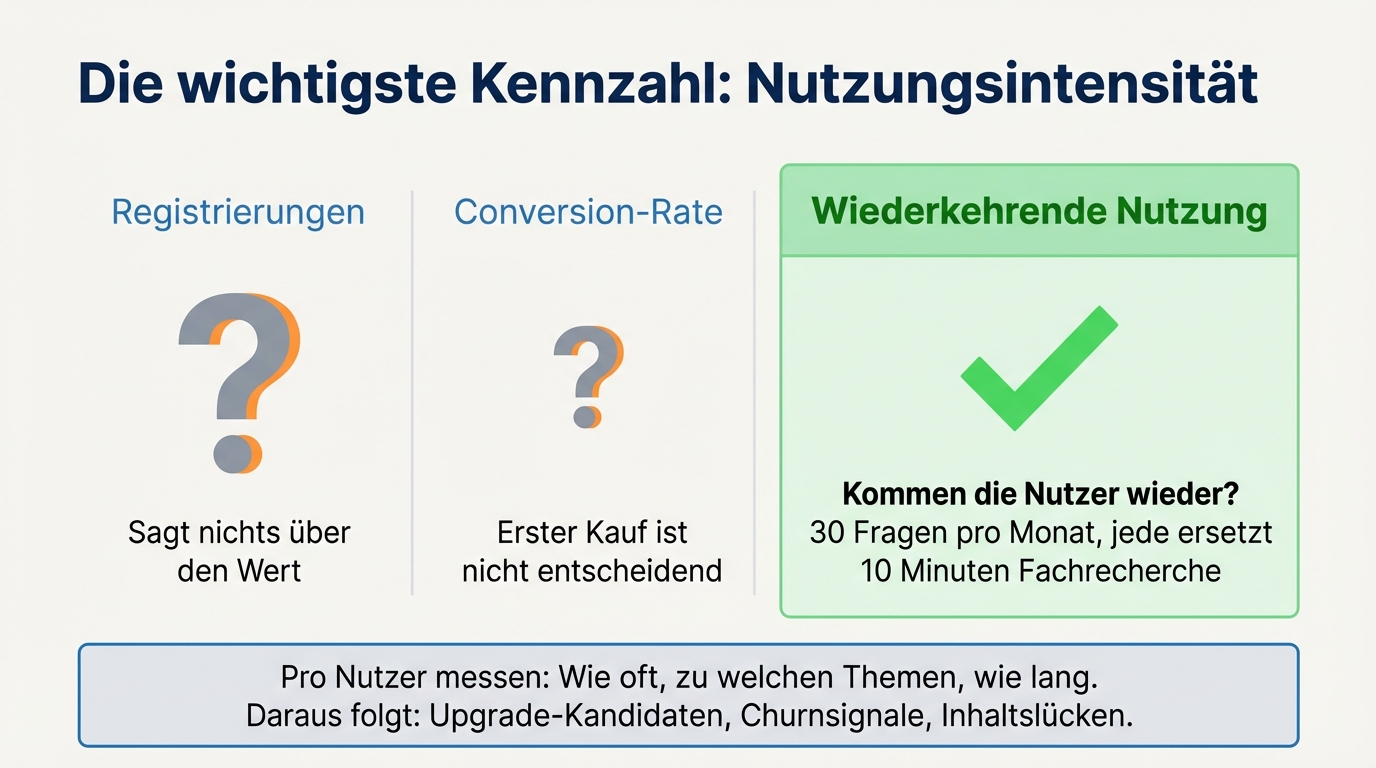
The most important metric for an AI product is usage intensity. Not the number of registrations, not the conversion rate on first purchase, but: do users come back?
Per user you measure: how often do they ask, about which topics, how long are the sessions? From this you can read which content is most in demand and should be expanded, which users are upgrade candidates, and which users have stopped using the product.
This data foundation is also the best justification for the pricing model. If the average user asks 30 questions per month and each answer is equivalent to ten minutes of expert research, the package price is easy to justify.
Launch, observe, adjust
The honest truth about pricing: no pricing model is right on day one. The right number of free uses, the optimal package price, the sensible differentiation between tiers -- all of this only becomes clear during live operation.
The pragmatic approach: start with a model based on common sense, then observe actual usage. Do all users exhaust their free allowance? Then it's too low. Does nobody leave the free tier? Then there's no compelling reason for the upgrade. Do many cancel after the first month? Then expectations don't match the experience.
The ability to adjust the model quickly is more important than the perfect launch.
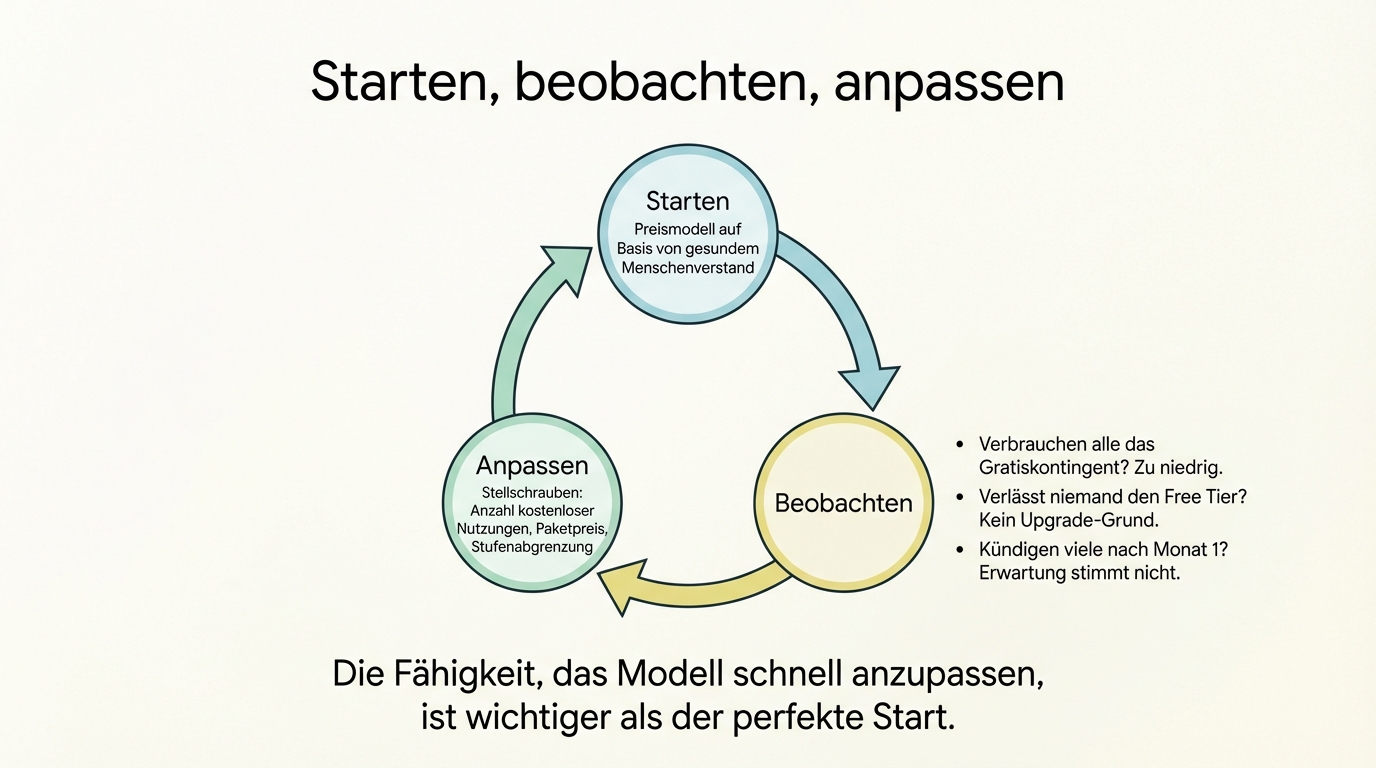
Technically, this means: allowances, tier limits, and unlocks belong in configuration, not in code. A change to the free tier must not be a development project.
Who an AI product with a subscription model suits
The model works wherever expertise already has a price but is tied to formats that don't scale:
- Specialist publishers with extensive collections of articles, commentaries, and practical guides.
- Associations and chambers whose members keep asking similar domain questions.
- Training and seminar providers whose participants still have questions after the event.
- Consultancies and expert assessors with years of accumulated report and methodology knowledge.
Three prerequisites must be met. You need a curated body of sources with usage rights clarified. You need a target group with recurring domain questions, because without recurring use there is no viable subscription. And you need a person who regularly checks answer quality and keeps the content up to date.
Frequently asked questions about monetizing AI products
How many free requests should a free tier include?
There is no fixed number. The allowance should be enough to recognise the answer quality, but not enough to cover the need completely. The starting value is an informed estimate. Usage then shows whether it is right: if all users exhaust the allowance, it is too low; if nobody pays, there is no reason to upgrade.
Should you charge per request or by subscription?
By subscription. A price per question inhibits exactly the intensive use through which users recognise the value. A subscription with practically unlimited questions and a fair-use limit has proven itself. Clearly defined add-ons such as an expert report or a training recording can be priced individually.
Why would customers pay when ChatGPT is free?
Because a general language model doesn't know the specific domain content and often guesses wrong on expert questions. A specialised assistant answers only on the basis of curated sources and cites them. This verifiability is what professionals pay for.
How can an AI product be integrated into existing offerings?
Most effectively as part of existing products: as an add-on to seminars, as part of a specialist portal subscription, or as a membership benefit. That way, no separate purchase decision is needed, and the assistant increases the perceived value of the overall offering.
Who develops AI assistants with freemium and subscription models?
Deyan7 develops AI assistants based on curated domain sources, with traceable source references and the usage tracking that a freemium or subscription model needs. How such systems are built is described in How specialist publishers and associations turn their expertise into an interactive product.
The next step
In a first conversation, we look at your knowledge base and your target group: which content is suitable as a foundation, which questions do your customers or members keep asking, and how does an AI assistant fit into your existing offering? Afterwards you'll know whether an AI product is viable for you and which pricing model to start with.